
n a swift and decisive response to a critical situation in space, China has launched an emergency uncrewed mission to pick up three astronauts who were stranded aboard the Tiangong space station. The astronauts had been left without a working spacecraft capable of returning them to Earth following damage sustained by the Shenzhou-20 spacecraft. This unprecedented move highlights the growing capabilities and the high stakes of China’s space program, as well as the nation’s commitment to ensuring the safety of its astronauts even in the face of unexpected challenges.
The Launch: A Race Against Time
On November 25, 2025, a Long March-2F rocket carrying the Shenzhou-22 spacecraft lifted off from the Jiuquan Satellite Launch Centre in northwestern China. The launch took place shortly after noon local time (04:00 GMT) and was broadcast live by CCTV, China’s state-run television. The Shenzhou-22 mission had initially been planned as a crewed mission to take place in 2026, but the circumstances surrounding the Shenzhou-20’s failure necessitated a rapid reassessment of timelines.
The Shenzhou-22 spacecraft, which was supposed to carry astronauts to the Tiangong space station, was brought forward to fill the gap left by Shenzhou-20. The damage to Shenzhou-20, which was still docked at the station and involved debris that made it unsafe for human travel, presented a major risk to the three astronauts aboard Tiangong. The emergency situation prompted Beijing to expedite the launch, putting China’s space program to the test in an unexpected and urgent manner.
A Stranded Crew: The Context Behind the Crisis
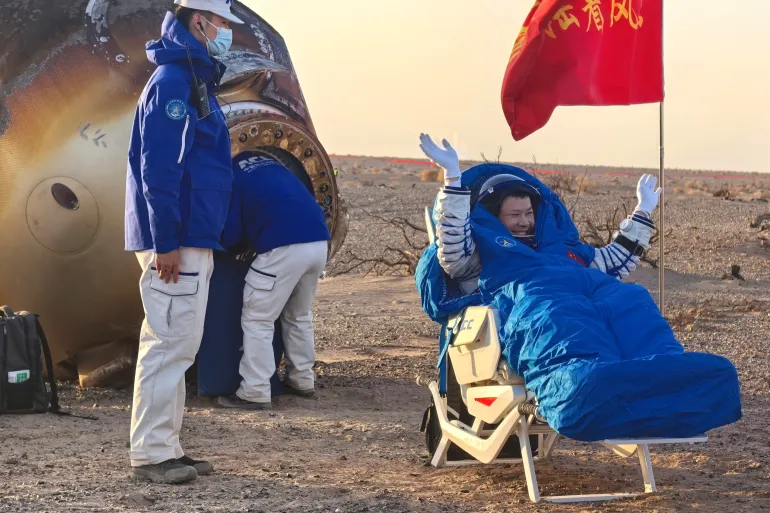
The crisis began when debris from space collided with the Shenzhou-20 spacecraft, which had been docked at the Tiangong space station since the April 2025 crew change. This collision rendered the spacecraft unable to safely carry humans back to Earth. Originally, the three astronauts aboard—Zhang Lu, Wu Fei, and Zhang Hongzhang—were scheduled to return using Shenzhou-20 at the end of their six-month mission. However, due to the damage, they were forced to rely on Shenzhou-21, which was then used to bring the crew members back to Earth.
This unexpected turn of events left Zhang Lu, Wu Fei, and Zhang Hongzhang, the current crew aboard the Tiangong space station, with no available spacecraft that could be used in case of an emergency or for a routine crew change. Given the importance of maintaining a flightworthy return vessel, the launch of the Shenzhou-22 became essential to ensure the crew’s safety, as they could not afford to have a situation where they were left stranded in space.
The Shenzhou-22 Mission: Filling the Gap
In response to this emergency, the Shenzhou-22 mission was launched with the goal of serving as a backup return capsule. The mission, which is uncrewed, will remain in orbit, ready to evacuate the astronauts if any dangerous situations arise aboard the space station. This precautionary measure demonstrates the level of planning and foresight embedded within China’s space program, ensuring that even in cases of unexpected accidents, the lives of astronauts can be safeguarded.
The crew of the Tiangong space station, including Zhang Lu, Wu Fei, and Zhang Hongzhang, are reported to be working normally and continuing their scientific research and station operations. Chinese officials have emphasized that the astronauts are in no immediate danger, but the Shenzhou-22 spacecraft is now in place to ensure that they can return to Earth safely in case of any emergency, thereby stabilizing operations aboard the station.
A Setback for China’s Space Program: Lessons Learned
This incident marks a rare setback for China’s otherwise successful and rapidly advancing space program. China’s space achievements in recent years have been significant, with the nation working tirelessly to establish itself as a dominant force in space exploration, aiming to match the space capabilities of countries like the United States, Russia, and the European Space Agency.
In 2022, China became the third country to send humans into orbit after the U.S. and the former Soviet Union. The Tiangong space station is central to China’s plans for long-term space exploration, and this incident highlights the challenges faced when operating in space, where unforeseen factors like space debris can cause major issues. However, the swift and effective response to the crisis with the Shenzhou-22 mission underscores China’s ability to overcome challenges and ensure that its space ambitions remain on track.
China’s Ambitious Space Program: A Future in Space Exploration
China’s space ambitions continue to grow as the nation looks to the future. The incident with Shenzhou-20 will likely push China to refine its technology and processes related to astronaut safety, spacecraft reliability, and space station management. The country’s space program is set to play a central role in global space exploration as China continues to ramp up its efforts to send astronauts to the moon by 2030. This is part of China’s broader goal of expanding its space exploration capabilities, developing new technologies, and creating a more sustainable space environment.
The Tiangong space station is at the heart of this vision, representing China’s growing capabilities in space. The station hosts a variety of research projects aimed at understanding space biology, physics, and materials science, which are essential for further deep-space exploration. The ability to build and maintain such a station places China at the forefront of space research and exploration, alongside other space-faring nations.
International Cooperation and Geopolitical Implications
The situation also reflects the broader geopolitical dynamics at play in space exploration. Space has increasingly become a domain of competition and collaboration, with countries striving to gain dominance in this new frontier. The U.S., Russia, and China have been major players in this arena, each pursuing their own space missions. China’s involvement in global space initiatives is steadily growing, with projects like the Belt and Road Initiative incorporating space exploration and infrastructure development into its scope.
While geopolitical tensions may influence space-related collaborations, the commonality of human exploration in space often leads to cooperation in various scientific fields. This growing space community underscores the importance of international collaboration in overcoming shared challenges in space exploration and technology development.
A New Era of Space Exploration and Safety
The launch of Shenzhou-22 in response to the unexpected damage to Shenzhou-20 has underscored the importance of contingency planning, technological readiness, and quick action in the high-stakes domain of space exploration. While China’s space program has been rapidly progressing toward its goal of becoming a space superpower, this incident serves as a reminder of the complexities and risks inherent in space operations. It also highlights China’s commitment to ensuring astronaut safety and the importance of maintaining a reliable infrastructure for space missions.
As China continues to expand its space exploration endeavors, the Shenzhou-22 mission reflects the country’s determination to overcome obstacles and push the boundaries of space exploration, while learning from challenges and building a more resilient space program for the future.