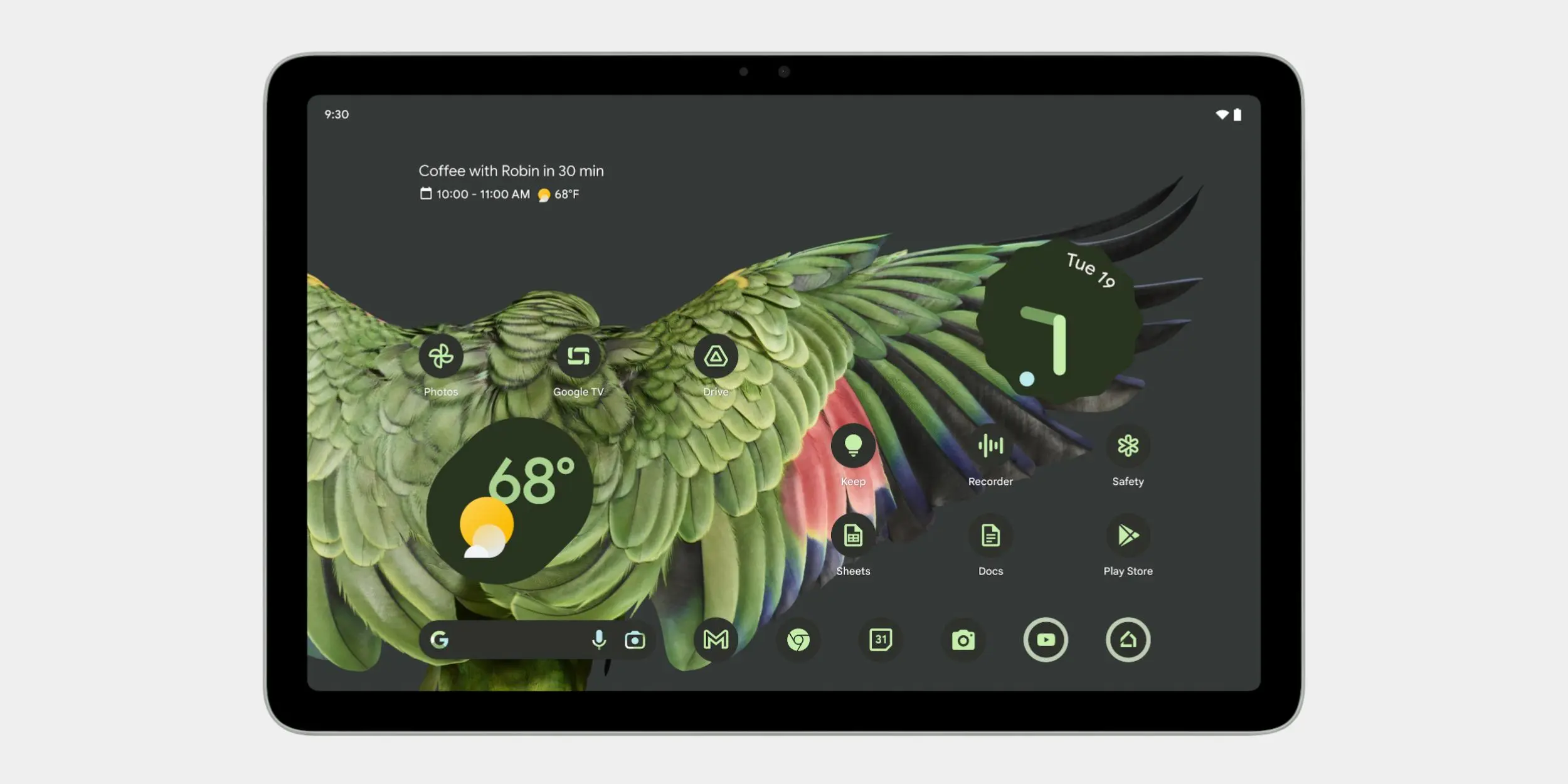
The Google Pixel Tablet, released on June 20, 2023, marked Google’s return to the tablet market after years of absence, showcasing a seamless blend of smart home integration and premium Android performance. Designed as both a standalone tablet and a smart display hub, it leveraged the Google Tensor G2 chipset—the same processor powering the Pixel 7 lineup—to deliver powerful AI-driven performance and deep ecosystem connectivity.
Running Android 13 with a promised upgrade path to Android 15, the Pixel Tablet aimed to redefine what an Android tablet could be. Weighing 493g and measuring 8.1mm thin, it featured a minimalist aluminum unibody design, a 10.95-inch IPS LCD display, quad-speaker setup, and stylus support for productivity and creativity. Paired with an innovative Charging Speaker Dock, the Pixel Tablet transformed into a smart home hub for Google Assistant, casting, and entertainment—blurring the line between tablet and home control center.
Google Pixel Tablet Full Specifications
| Category | Specification |
|---|---|
| Launch | Announced May 10, 2023; Released June 20, 2023 |
| Status | Available |
| Network | No cellular connectivity |
| Body Dimensions | 258 x 169 x 8.1 mm (10.16 x 6.65 x 0.32 in) |
| Weight | 493 g (1.09 lb) |
| Build | Glass front, aluminum frame, aluminum back |
| SIM | No SIM |
| Stylus Support | Yes |
| Display Type | IPS LCD |
| Display Size | 10.95 inches, 347.7 cm² (~79.7% screen-to-body ratio) |
| Resolution | 1600 x 2560 pixels, 16:10 ratio (~276 ppi density) |
| Platform | Android 13, upgradable to Android 15 |
| Chipset | Google Tensor G2 (5 nm) |
| CPU | Octa-core (2×2.85 GHz Cortex-X1 & 2×2.35 GHz Cortex-A78 & 4×1.80 GHz Cortex-A55) |
| GPU | Mali-G710 MP7 |
| Internal Storage | 128GB / 256GB (UFS 3.1) |
| RAM | 8GB |
| Card Slot | No |
| Main Camera | Single: 8 MP, f/2.0, 24mm (wide), 1/4.0″, 1.12µm |
| Camera Features | HDR, panorama |
| Video | 1080p@30fps |
| Selfie Camera | 8 MP, f/2.0, 24mm (wide), HDR, panorama |
| Selfie Video | 1080p@30fps |
| Sound | Quad stereo speakers, no 3.5mm jack |
| Connectivity | Wi-Fi 802.11 a/b/g/n/ac/6 (dual-band), Bluetooth 5.2, USB Type-C 3.2 (Gen 1), magnetic connector |
| Positioning | None |
| NFC / Radio | No |
| Sensors | Accelerometer, gyro, compass, proximity (accessories only), UWB support |
| Battery Type | Li-Po 7020 mAh (27 Wh) |
| Charging | 15W wired |
| Colors | Porcelain, Hazel, Rose |
| Models | GA06156-EU, GA06157-EU, GA06158-EU |
| Price | About 670 EUR |
Display and Design
The Google Pixel Tablet combined modern aesthetics with practical design, embracing an aluminum chassis and matte finish that enhanced both durability and grip. Available in elegant color options like Porcelain, Hazel, and Rose, it projected minimalist sophistication typical of Google hardware. Despite its large display, the tablet maintained a balanced weight distribution, ensuring comfort during prolonged use.
Its 10.95-inch IPS LCD offered a crisp 1600 x 2560 resolution with a 16:10 aspect ratio, ideal for multitasking and streaming. The screen’s vivid color reproduction and excellent brightness levels made it suitable for both productivity and media consumption. Though it lacked OLED technology, its balance between clarity, brightness, and color accuracy provided an enjoyable viewing experience, especially when docked for ambient content or video playback.
Performance
At its core, the Pixel Tablet ran on the Google Tensor G2 processor—the same powerhouse found in the Pixel 7 series—ensuring flagship-level performance for an Android tablet. The Tensor G2 combined AI processing with machine learning acceleration, enabling intelligent multitasking, optimized voice commands, and smart photo editing. The Mali-G710 MP7 GPU delivered excellent graphical performance for streaming, light gaming, and creative work.
With 8GB of RAM and UFS 3.1 storage, app switching felt fluid, and productivity tasks such as split-screen multitasking performed smoothly. Tensor’s efficiency also improved energy management, keeping the tablet cool and responsive during extended sessions. Google’s collaboration with developers for large-screen optimization ensured that apps like YouTube, Meet, and Docs looked and performed perfectly on the tablet’s expansive display.
Camera
While not designed as a photography powerhouse, the Pixel Tablet’s dual 8MP cameras—front and rear—handled video calls and casual photography with clarity and balance. Both sensors supported HDR and 1080p video recording, providing consistent image quality. The front camera’s wide field of view made it ideal for Google Meet calls and group video chats. Enhanced by Tensor G2’s AI-driven imaging pipeline, it delivered superior dynamic range and skin tone accuracy compared to other tablets in its class.
Smart Home Integration
One of the standout features of the Pixel Tablet was its Charging Speaker Dock, which transformed it into a smart display powered by the Google Home ecosystem. When docked, it acted as a Nest Hub, allowing users to control smart devices, stream entertainment, view photos, or use it as a hands-free assistant. The four built-in speakers provided rich sound, making it a central piece for both productivity and entertainment. Its Ultra Wideband (UWB) support also enabled seamless device handoffs and spatial awareness within the Google ecosystem.
Battery and Charging
The 7020mAh battery offered impressive longevity, delivering up to 12 hours of continuous video playback. It supported 15W wired charging via USB-C and conveniently recharged when attached to the magnetic dock. Tensor G2’s efficiency contributed to longer on-screen times and better standby endurance, ensuring the tablet was always ready for use whether docked or on the go.
Durability
With its aluminum construction and solid build, the Pixel Tablet was built to last. Its UWB connectivity, Android optimization, and long-term update guarantee made it future-proof. The design emphasized sustainability, incorporating recycled materials and energy-efficient components—a reflection of Google’s eco-conscious hardware philosophy.
Overall, the Google Pixel Tablet was more than a productivity tool—it was the centerpiece of a connected home. Offering premium performance, smart versatility, and clean design, it bridged the gap between entertainment and utility, reaffirming Google’s commitment to an integrated Android ecosystem.