

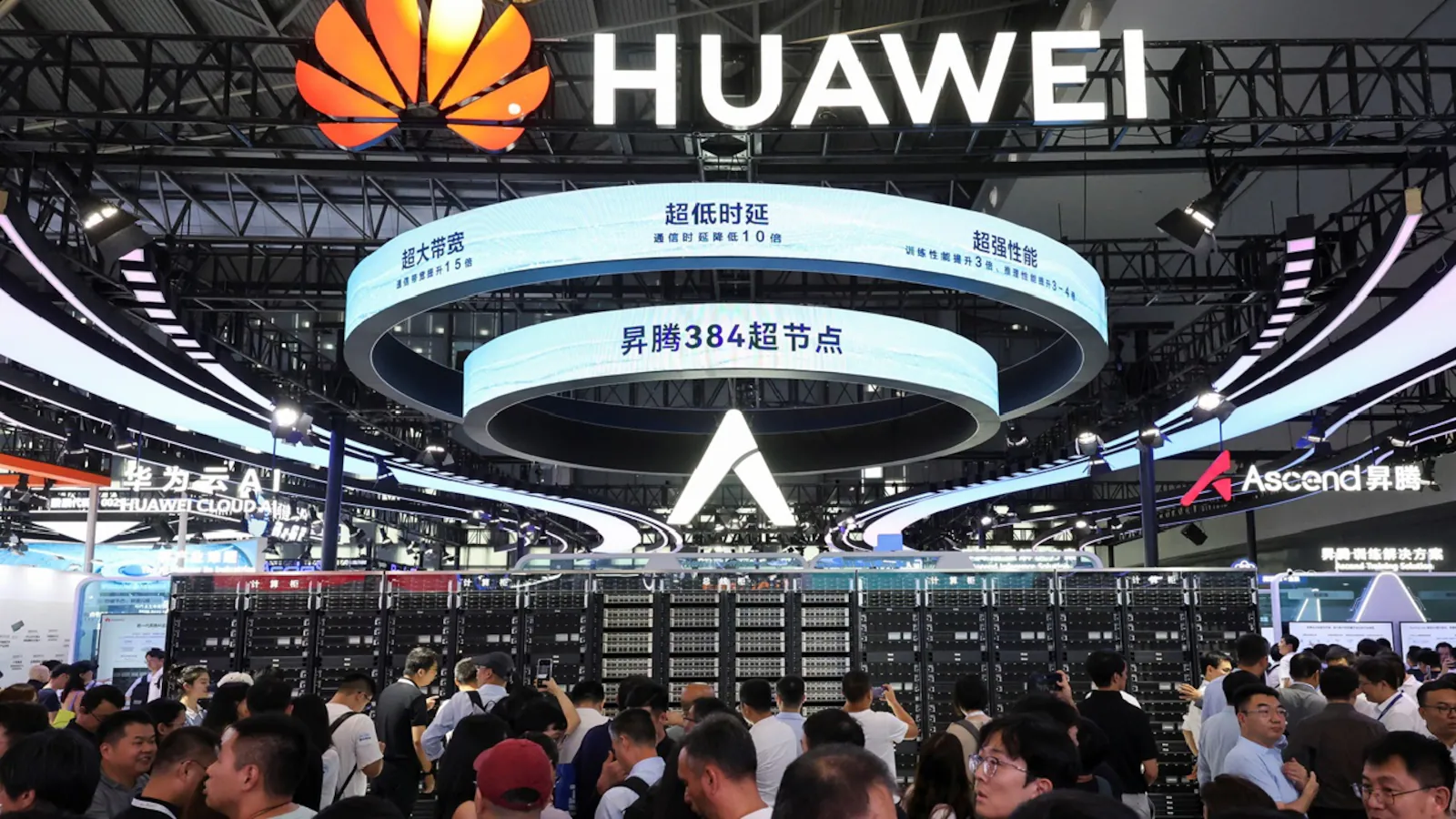
Huawei Technologies has announced ambitious plans to launch what it claims will be the world’s most powerful AI computing clusters over the next two years. The company aims to outperform global technology leaders despite relying on less advanced domestic semiconductors. This move comes as China intensifies its efforts to become less dependent on imported tech, especially as the U.S. continues to impose restrictions on high-end chip exports to China.
China’s Push for Tech Self-Reliance
China is racing to build its own technological capabilities, particularly in the fields of artificial intelligence (AI) and high-performance computing. The Chinese government has encouraged local companies to cut their reliance on foreign technology, including the most advanced chips. Huawei is at the forefront of this drive to develop home-grown alternatives to the dominant U.S. technologies. This push aligns with China’s broader objective of transforming itself into a global tech leader.
Huawei’s upcoming superpods, the Atlas 950 and Atlas 960, are central to this vision. Set to launch in late 2026 and 2027, these superpods are high-performance computing systems made up of interconnected computers that combine the processing power of thousands of chips. Despite using domestic chips, which are not as powerful as those from Nvidia or other leading global chipmakers, Huawei believes this approach will allow it to compete with the best in the industry.
AI as a Key Focus for Competition
AI is a growing area of competition between the U.S. and China. For Huawei, developing powerful AI computing systems is essential to securing a place in this global race. AI’s potential to drive economic and technological growth makes it a critical focus for governments and tech companies around the world. Huawei’s goal is to build a system capable of running large-scale AI models, which requires immense computing power. The Atlas 950 and 960 superpods will be integral in helping Huawei achieve this goal.
To overcome the limitations of using less powerful semiconductors, Huawei is leveraging a new computing architecture designed to efficiently utilize many chips at once. This innovative approach allows Huawei to connect dozens of superpods to create a powerful network known as “SuperClusters.” These SuperClusters are intended to be the most powerful computing systems globally, despite the company’s reliance on chips that aren’t as advanced as those from companies like Nvidia.
Strategic Vision for Long-Term Growth
Huawei’s vision extends beyond just building powerful AI systems—it also aims to create a sustainable, long-term solution to meet the growing demand for computing power. Eric Xu, the rotating chairman of Huawei, explained the company’s strategy: “Our strategy is to create a new computing architecture, and develop computing SuperPoDs and SuperClusters, to sustainably meet long-term demand for computing power.” By focusing on scalability and efficiency, Huawei plans to ensure that its AI systems can handle the increasing computational demands of the future.
The Atlas 950 and 960 superpods are expected to remain the most powerful systems for years to come, according to Huawei’s product roadmaps. The company’s approach reflects its belief that it can build a competitive edge in the AI field, even without access to the world’s most powerful semiconductors. By connecting multiple superpods into SuperClusters, Huawei plans to create a computing system that can rival the performance of the best systems in the world.
The Challenges of Competing Without Advanced Semiconductors
One of Huawei’s biggest challenges is its inability to access the most advanced chips from companies like Nvidia, which dominate the high-performance computing market. These chips are used by many of the top players in the AI space, including U.S. tech giants like Google and OpenAI. Huawei’s reliance on less powerful chips means that the company has to find ways to make its computing systems work efficiently despite these limitations.
However, Huawei’s innovative approach to building large-scale AI systems through SuperClusters offers a potential solution. Instead of focusing on individual chips, the company is designing a system that can harness the power of many chips working together. This strategy may help Huawei compensate for the lack of access to the most advanced semiconductors and still deliver the computing power necessary to compete on a global scale.
Huawei’s Role in the Global Tech Landscape
Huawei’s plan to develop the world’s most powerful AI computing clusters represents a bold step in its efforts to compete with global tech giants. Despite the challenges posed by its reliance on less advanced semiconductors, Huawei’s approach could redefine the future of AI and high-performance computing. By developing its own technology and building innovative systems, Huawei is positioning itself as a key player in the global tech race.
With the launch of the Atlas 950 and 960 superpods, Huawei is not only aiming to outperform its competitors but also to help shape the future of AI technology. The company’s ability to leverage its own chips and create large-scale SuperClusters could give it a competitive advantage in the long term. As the U.S. and China continue to vie for supremacy in the AI field, Huawei’s strategic focus on domestic technology and innovative computing architectures may help it emerge as a leader in the global tech landscape.


