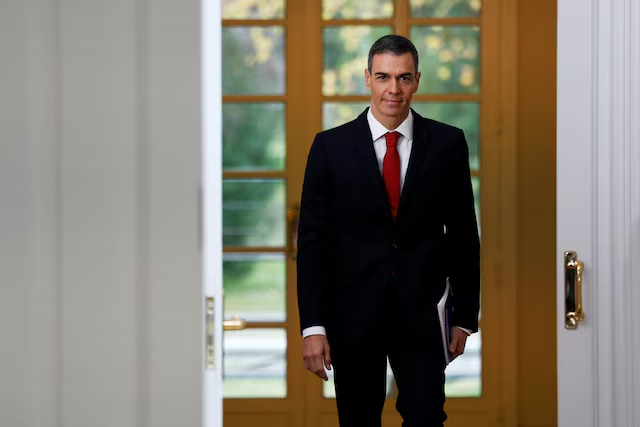
Spain coup documents declassification marks a pivotal moment for historical transparency. Furthermore, Prime Minister Pedro Sanchez announced this significant decision. Consequently, the public gains access to previously restricted files. Specifically, these documents relate to the 1981 attempted coup. Thus, citizens can better understand this critical historical event. Moreover, democracies benefit from examining their past challenges. Indeed, transparency strengthens institutional trust significantly. Therefore, this initiative supports democratic consolidation efforts.
Understanding The Spain Coup Documents Declassification Initiative
The declassification process addresses a historic debt to citizens. Specifically, repeated public requests motivated this policy shift. Moreover, the files will publish on Wednesday officially. Consequently, researchers and historians gain valuable primary sources. Additionally, these documents may clarify institutional roles during the crisis. Hence, accountability mechanisms strengthen through open access. Notably, Spain coup documents declassification supports educational objectives. Therefore, future generations learn from documented historical evidence. Meanwhile, archival preservation ensures long-term accessibility. Thus, scholarly analysis benefits from comprehensive source materials.
Former King Juan Carlos I’s role warrants particular examination. Specifically, his televised address helped defeat the coup attempt. Moreover, intelligence agencies’ involvement requires careful scrutiny. Additionally, state institutions’ responses during the crisis merit analysis. Consequently, these documents may reveal coordination patterns. Hence, historical narratives gain nuance through primary evidence. Notably, Spain coup documents declassification addresses lingering questions. Therefore, public understanding of democratic resilience improves. Meanwhile, missing documents complicate comprehensive reconstruction efforts. Thus, researchers must work with available materials carefully.
Historical Context Of The 1981 Coup Attempt
The failed coup occurred during Spain’s democratic transition. Specifically, Antonio Tejero led Civil Guard forces into parliament. Moreover, gunmen fired shots and held lawmakers hostage. Consequently, the swearing-in ceremony faced violent interruption. Additionally, the plotters aimed to restore dictatorship. Hence, democratic institutions confronted an existential threat. Notably, King Juan Carlos’s televised address proved decisive. Therefore, constitutional order received crucial royal support. Meanwhile, the siege lasted approximately 17 hours. Thus, democratic forces ultimately prevailed through coordinated resistance.
The coup’s collapse demonstrated institutional commitment to democracy. Specifically, elected officials maintained composure under extreme pressure. Moreover, security forces ultimately rejected the unlawful seizure. Consequently, public support for constitutional governance strengthened. Additionally, international observers monitored the crisis closely. Hence, Spain’s democratic credibility faced a critical test. Notably, this event shaped subsequent political development. Therefore, lessons from 1981 inform contemporary governance. Meanwhile, historical memory influences current civic engagement. Thus, understanding past challenges supports future resilience.
Transparency Benefits For Democratic Societies
Open access to historical records strengthens civic education. Specifically, primary sources enable evidence-based historical analysis. Moreover, transparent archives support academic research objectives. Consequently, public discourse benefits from documented facts. Additionally, institutional accountability improves through historical scrutiny. Hence, democratic norms reinforce through learning processes. Notably, Spain coup documents declassification exemplifies best practices. Therefore, other nations may adopt similar transparency measures. Meanwhile, balanced interpretation requires contextual understanding. Thus, historians provide essential analytical frameworks.
Public trust in institutions grows through transparent practices. Specifically, acknowledging historical complexities demonstrates institutional maturity. Moreover, confronting difficult past events supports reconciliation. Consequently, societal cohesion strengthens through shared understanding. Additionally, educational curricula incorporate verified historical content. Hence, critical thinking skills develop through source analysis. Notably, democratic resilience depends on historical awareness. Therefore, citizens engage more effectively with governance processes. Meanwhile, media literacy improves through access to primary materials. Thus, informed publics support accountable leadership.
Challenges In Historical Document Recovery
Missing documents complicate comprehensive historical reconstruction. Specifically, former spy chief Alberto Saiz warned about disappearances. Moreover, archival gaps limit analytical completeness. Consequently, researchers must acknowledge evidentiary limitations.
Additionally, contextual interpretation requires careful methodological approaches. Hence, historical conclusions remain provisional when sources are incomplete. Notably, Spain coup documents declassification still provides valuable insights. Therefore, available materials merit thorough scholarly examination. Meanwhile, future discoveries may enhance understanding further. Thus, historical research remains an evolving process.
Balancing transparency with security considerations presents ongoing challenges. Specifically, sensitive information requires careful review before release. Moreover, privacy protections for individuals warrant attention. Consequently, declassification protocols follow established legal frameworks. Additionally, redaction processes protect legitimate confidentiality interests. Hence, responsible transparency supports both openness and security. Notably, democratic societies navigate these tensions through deliberative processes. Therefore, public consultation informs policy development. Meanwhile, independent oversight enhances procedural credibility. Thus, balanced approaches serve multiple societal interests.
The Spain coup documents declassification initiative represents significant progress. Furthermore, historical transparency strengthens democratic foundations substantially. Consequently, citizens gain deeper understanding of institutional resilience. Moreover, scholarly research benefits from expanded source access. Specifically, primary documents enable nuanced historical analysis. Thus, educational outcomes improve through evidence-based learning. Indeed, confronting historical challenges supports contemporary governance. Therefore, democratic societies thrive through reflective practice. Meanwhile, institutional accountability strengthens through open records. Hence, public trust grows through transparent operations.
Ultimately, understanding the past informs future decision-making. The commitment to historical truth guides all efforts. Consequently, democratic values receive renewed reinforcement. Furthermore, civic engagement deepens through informed participation. Thus, Spain coup documents declassification supports long-term democratic health. Ultimately, transparent societies build resilient futures together.