
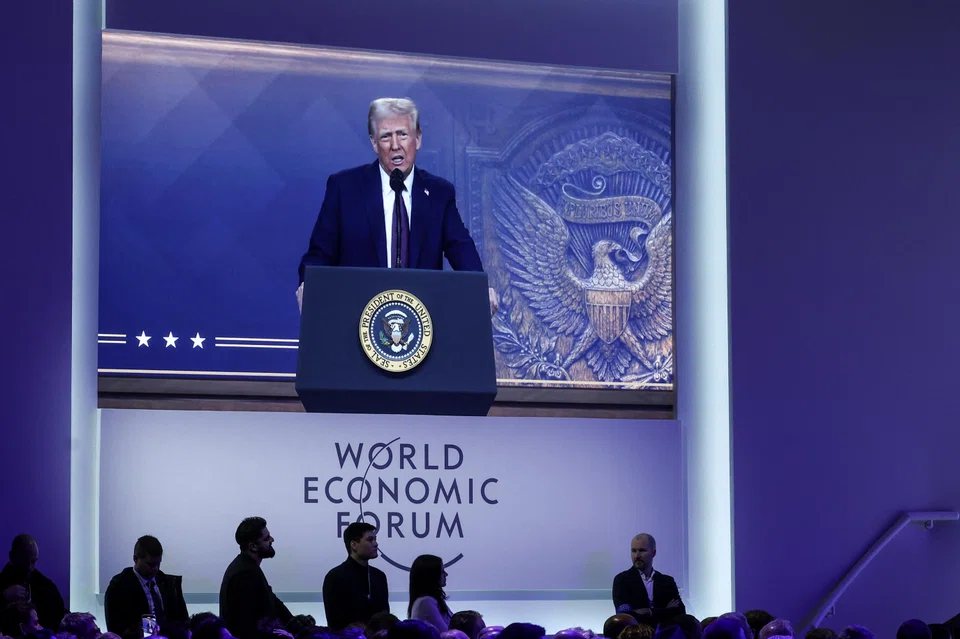
The annual meeting of the World Economic Forum returns to Davos at a moment of exceptional global instability. Political risk, trade disruption, and geopolitical rivalry now dominate conversations that once focused on growth and globalization.
Executives, policymakers, and investors arrive with caution. Many companies now prioritize resilience over expansion. They plan for disruption rather than stability. This shift reflects a global system under strain.
At the center of the debate stands Donald Trump, whose leadership continues to redefine the relationship between the United States and the global economic order.
Trump’s Presence Challenges Davos’ Globalist Foundations
Trump has built his political identity around rejecting globalism. Yet, he remains drawn to Davos. His attendance creates a paradox that shapes the entire forum.
Armed with an “America First” agenda, Trump arrives with a powerful delegation. It includes senior officials overseeing finance, trade, energy, and technology. Their goal is straightforward. They seek leverage, not consensus.
Under Trump’s leadership, the United States has shifted course. It no longer positions itself as the guardian of global rules. Instead, it openly challenges institutions and norms created after 1945. This change unsettles allies and competitors alike.
For business leaders, this shift creates uncertainty. Global rules no longer feel permanent. Strategic planning must now assume political volatility.
Global Policy Uncertainty Reaches a Two-Decade High
A new report released by the WEF confirms what executives already feel. The study, conducted with Boston Consulting Group and IMD Business School, finds global policy uncertainty at its highest level in twenty years.
Several forces drive this trend. Multilateral institutions struggle to enforce rules. Trade policy changes faster than supply chains can adapt. Governments increasingly weaponize economic tools.
As a result, companies face harder choices. Long-term investments carry higher risk. Cross-border operations demand constant political monitoring. Stability can no longer be assumed.
Geopolitical Risk Now Threatens the Global Economy
The insurance industry has issued stark warnings. Lloyd’s of London estimates that a major geopolitical conflict could cost the world US$14.5 trillion within five years.
Global trade remains highly exposed. More than 80 percent of all goods move by sea. Key shipping routes concentrate enormous economic value. Any closure would trigger immediate global disruption.
Energy markets face particular danger. Food security also remains vulnerable. Manufacturing hubs depend on uninterrupted logistics. Businesses now treat geopolitical conflict as a core financial risk.
Trade Tariffs Return as a Tool of Political Pressure
Trump recently reinforced these fears. He warned that any country trading with Iran could face a 25 percent tariff. This statement sent shockwaves across global markets.
Iran maintains deep trade ties with major economies. China leads the list, followed by India, Turkey, Iraq, and the United Arab Emirates. Even limited enforcement could ripple across Asia and the Middle East.
The episode highlights a broader reality. Trade policy now serves as a geopolitical weapon. Governments deploy tariffs to influence behavior. Companies must prepare for sudden and unilateral decisions.
Davos Still Offers Pockets of Optimism
Despite the tense backdrop, Davos 2026 does not lack hope. One development stands out. Trump and Volodymyr Zelensky plan to sign a US$800 billion agreement aimed at rebuilding Ukraine.
The deal builds on a 2025 minerals agreement. That earlier pact granted US investors preferential access to future Ukrainian mining projects. The new framework seeks to unlock private loans, grants, and long-term investment.
For Ukraine, the agreement represents an economic lifeline. For global markets, it signals that cooperation remains possible, even in divided times.
The World Economic Forum’s Legacy of Dialogue
The WEF has long served as a platform for diplomacy. Davos previously hosted landmark discussions that shaped history. These include early talks between Greece and Turkey, North and South Korea, and leaders involved in German reunification.
That legacy continues to matter. In an era of fragmentation, Davos still provides rare space for engagement. The Ukraine agreement reflects this enduring role.
Global Cooperation Is Evolving, Not Collapsing
A second WEF study provides further insight. Developed with McKinsey & Company, the Global Cooperation Barometer 2026 paints a nuanced picture.
Traditional multilateral cooperation continues to weaken. Trade and security frameworks show the sharpest decline. However, targeted cooperation proves more resilient.
Regional and interest-based partnerships now dominate. Countries collaborate where benefits align. Flexibility replaces universal commitments.
Technology Leads New Forms of Collaboration
Innovation offers one of the strongest areas of cooperation. Cross-border data flows continue to grow. International internet bandwidth now stands four times higher than before the pandemic.
Countries also deepen collaboration around artificial intelligence, digital infrastructure, and advanced manufacturing. These partnerships often involve smaller groups with shared goals.
Such models reflect a pragmatic approach. Cooperation survives where it delivers clear value.
What Davos 2026 Signals for Global Business
The message from Davos remains complex. Risk defines the global outlook. Yet opportunity still exists.
Businesses that understand new cooperation patterns can adapt faster. Regional strategies may outperform global ones. Flexibility now outweighs scale.
In a volatile and uncertain world, leaders who balance caution with selective engagement will strengthen resilience and long-term competitiveness.


