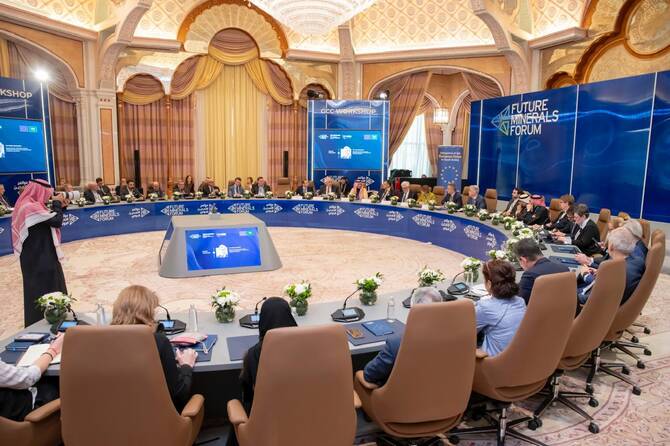
The European Union and Saudi Arabia have signalled a deepening strategic alignment with the launch of their first-ever joint roundtable on critical raw materials, underscoring a shared commitment to securing resilient, diversified, and sustainable supply chains. The high-level dialogue, held in Riyadh on the margins of the Future Minerals Forum, brought together senior policymakers, industry executives, and investors to translate policy priorities into concrete cooperation across the minerals value chain.
The meeting comes at a time when critical raw materials such as lithium, rare earth elements, and cobalt have become central to global economic security, driven by accelerating demand from clean energy technologies, electric vehicles, advanced manufacturing, and digital infrastructure.
A Strategic EU–Saudi Policy Convergence
The roundtable was organised under a Team Europe approach by the EU–GCC Cooperation on Green Transition Project, in coordination with the EU Delegation to Saudi Arabia and the European Chamber of Commerce in Saudi Arabia, working closely with the Future Minerals Forum. It provided a platform to align European policy frameworks with Saudi Arabia’s minerals, industrial, and investment ambitions.
On the European side, discussions centred on the EU Critical Raw Materials Act and ResourceEU, a strategic action plan launched in late 2025. ResourceEU aims to strengthen Europe’s resilience by reducing dependence on single suppliers, expanding domestic extraction and processing, scaling up recycling and stockpiling, and building long-term partnerships with resource-rich countries.
For Saudi Arabia, the dialogue aligns closely with Saudi Vision 2030, which places mining and minerals at the heart of the Kingdom’s economic diversification agenda. Saudi Arabia is seeking to develop globally competitive mineral hubs, expand downstream processing, and integrate more deeply into international value chains.
Turning Strategy Into Practical Cooperation
The opening of the roundtable by Christophe Farnaud and Turki Al-Babtain highlighted the political importance both sides attach to the initiative. The message was clear: policy alignment must now be matched by tangible business and investment outcomes.
European representatives emphasised that international cooperation is essential for implementing the EU’s critical raw materials strategy, given the global nature of supply chains and the concentration of production in a small number of countries. Saudi Arabia was described as a key partner capable of contributing to secure, sustainable, and responsibly sourced minerals supply.
From the Saudi perspective, the dialogue was framed as a vehicle to accelerate industrial transformation, attract high-quality foreign investment, and promote responsible mining practices. Strengthening upstream and downstream integration, officials noted, will be critical to capturing greater value from the Kingdom’s mineral resources.
Covering the Entire Value Chain
Discussions at the roundtable spanned the full critical raw materials value chain. Participants explored opportunities in exploration and geological surveying, mining development, processing and refining, and the expansion of recycling capabilities. Downstream manufacturing, logistics, and the mobilisation of private capital and sustainable finance also featured prominently.
A recurring theme was the need to embed high environmental, social, and governance standards throughout these value chains. Both the EU and Saudi Arabia see ESG alignment not only as a regulatory requirement, but also as a competitive advantage in attracting global investors and long-term industrial partners.
Decarbonisation, Industry, and Investment
The European Commission was represented by Valere Moutarlier, deputy director-general responsible for European industry decarbonisation within the Directorate-General for Internal Market, Industry, Entrepreneurship and SMEs. She highlighted how the EU Critical Raw Materials Act and ResourceEU provide a clear, predictable framework for strengthening Europe’s industrial base while deepening cooperation with international partners.
According to Moutarlier, collaboration with Saudi Arabia is essential to building secure and diversified supply chains that can withstand geopolitical and market shocks. Structured dialogues such as the Riyadh roundtable, she said, are vital for converting high-level policy ambitions into real industrial projects and cross-border investment flows.
Broader Regional and Global Implications
While the dialogue focused on EU–Saudi cooperation, its significance extends far beyond the two parties. As global competition for critical minerals intensifies, countries and regions are increasingly seeking trusted partners to ensure long-term supply security. Saudi Arabia’s ambition to position itself as a global minerals and processing hub places it at the intersection of Europe, Africa, and Asia.
At the same time, the EU’s push to diversify its supply chains opens new avenues for cooperation across the GCC, the wider Middle East and North Africa, and resource-rich African countries. The roundtable reflects a shared recognition that future economic resilience, energy security, and technological leadership depend on collaboration, transparency, and long-term partnerships.
Laying the Foundations for Long-Term Partnership
The first EU–Saudi roundtable on critical raw materials marks an important milestone in bilateral relations, signalling a move from policy alignment toward implementation. By bringing together governments, industry, and investors, the dialogue lays the groundwork for sustained cooperation in one of the most strategically important sectors of the global economy.
As follow-up engagements and projects emerge from this initial meeting, the EU–Saudi partnership on critical raw materials is expected to play an increasingly influential role in shaping global supply chains, supporting the green and digital transitions, and reinforcing economic ties between Europe and the Middle East.