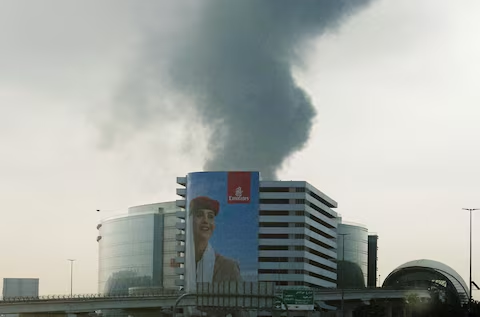
Pilots must receive a final and non-negotiable say allowing them to refuse to fly over or within conflict zones. This authority must come without influence from commercial pressures, the International Federation of Air Line Pilots’ Associations (IFALPA) said. The global union group issued a position paper on Monday addressing safety concerns amid the ongoing Iran war.
The six-week-long Iran war is reshaping airspace across the Middle East. Drone and missile attacks and interceptions are increasing disruptions to flights. These events heighten safety risks for airline crew members and their passengers. Montreal-based IFALPA said airlines should recognize how conflict zone operations can create mental and emotional strain in the cockpit.
Pilots Conflict Zone Authority Must Remain Final, IFALPA Argues
The position paper outlined clear demands regarding pilots conflict zone authority. “The Commander’s decision regarding the conduct or rerouting of a flight, including refusal to overfly a conflict zone, must be final and non-negotiable,” the paper said. “Additionally, this decision must not be influenced by financial or other incentives, career repercussions or other penalties, or commercial pressures.”
Many carriers have canceled services to affected destinations. However, Dubai-based Emirates is now operating at about 69% of its normal capacity. Qatar Airways is operating at 26%, according to Flightradar24 data. These figures equate to hundreds of flights per day in airspace that Iranian missiles and drones have targeted.
The United Arab Emirates has instituted safe corridors with specific flight paths. Nevertheless, planes still regularly enter holding patterns during attacks. In some cases, flights have been turned back or diverted to other destinations when airspace closed temporarily. Qatar Airways said “the safety of our passengers and crew remains paramount.” The airline operates all flights to and from Doha through dedicated flight corridors established with the Qatar Civil Aviation Authority. Emirates, which has also said it prioritizes safety, did not immediately respond to a request for comment.
IFALPA’s paper said airlines need to provide pilots operating in conflict zones with mitigation measures. These include post-flight recuperation time and confidential support. “If rerouting, delay, holding, elevated workload, diversion complexity, or sector uncertainty are recurrent and foreseeable, they should be incorporated into scheduling assumptions, fatigue controls, and roster buffers with additional safety margins such as augmented crew rostering, rather than repeatedly managed as an ad hoc exception,” the paper stated.
UN Agency Condemns Iran as Pilots Conflict Zone Authority Debate Intensifies
Separately on Monday, the United Nations aviation agency said its governing council condemned Iran for unlawful airspace violations against Gulf neighbors. These violations affect civil aviation safety in the UAE, Qatar, and Saudi Arabia. “The council deplored Iran’s illegal use of unmanned aircraft systems for military purposes against civilian infrastructure over the territories of the affected member states,” the International Civil Aviation Organization said in a statement.
The council’s decision follows a paper submitted by multiple Arab states over Iran’s use of weaponized drones against its neighbors, a source familiar with the matter said. Iran has submitted a separate paper regarding its territory that is to be heard during a future council session. The source was not familiar with specific details of that submission.
The debate over pilots conflict zone authority comes as commercial aviation faces unprecedented challenges. Middle Eastern carriers serve as global transit hubs connecting East and West. Any prolonged disruption affects millions of passengers worldwide. IFALPA represents more than 150,000 pilots globally. The union’s stance could influence regulatory changes at national aviation authorities.
Safety experts note that commercial pressures have historically influenced pilot decisions. Some carriers have reportedly discouraged crews from refusing flights to high-risk destinations. IFALPA’s demand for non-negotiable authority seeks to eliminate that dynamic entirely. The coming weeks will determine whether airlines and regulators adopt these recommendations. Meanwhile, flights continue through contested airspace with pilots navigating both physical and psychological hazards.