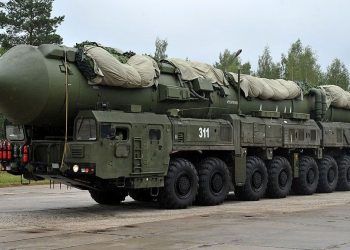
On December 30, 2025, Russia officially announced the deployment of its nuclear-capable Oreshnik missile system to Belarus, marking a significant milestone in the ongoing escalation of tensions between Russia, Ukraine, and the Western world. The Oreshnik missile, which has been described by Russian officials as one of the most advanced and formidable weapons in Russia’s arsenal, has entered active service. This announcement came after a brief ceremony in Belarus, Russia’s key ally, which has supported Moscow’s military actions in Ukraine.
The Oreshnik missile, which has the ability to carry both conventional and nuclear warheads, is designed to strike high-value targets with unparalleled speed and precision. Its deployment, as part of an agreement between Russian President Vladimir Putin and Belarusian President Alexander Lukashenko, is part of a broader strategy to reinforce the security guarantees of the Union State, a political and military alliance between Russia and Belarus. This move is likely to further heighten tensions in an already volatile region, with implications not only for the ongoing war in Ukraine but also for the stability of Europe and NATO.
The Oreshnik Missiles: A Game-Changer in Warfare
The Oreshnik missile system, named after the Russian word for “hazelnut tree,” entered the public eye in November 2024 when it was first used in combat. It was deployed against a missile factory in Dnipro, Ukraine, during the ongoing conflict between Russian and Ukrainian forces. The missile’s capabilities are described as groundbreaking, with its ability to travel at speeds of up to Mach 10, making it nearly impossible to intercept using existing missile defense technologies. Russian President Putin has repeatedly praised the weapon’s ability to obliterate its targets, likening its effect to a meteorite strike, capable of reducing targets to “elementary particles.”
The Oreshnik is categorized as an intermediate-range missile, which gives it a range between 310 and 3,400 miles. This range allows it to strike anywhere within Europe, including NATO countries, with devastating speed. Russian officials have made it clear that the Oreshnik could be used as a retaliatory measure against NATO nations, particularly those that have supported Ukraine with longer-range missile systems, enabling Ukraine to strike deep into Russian territory. The missile’s potential to carry nuclear warheads adds another layer of danger to its deployment, as it could be seen as a significant escalation in the ongoing geopolitical standoff.
The Strategic Deployment in Belarus
The decision to deploy the Oreshnik missiles in Belarus is a major development in the context of the ongoing conflict in Ukraine. Belarus shares a border with both Russia and Ukraine, positioning it as a key strategic ally for Moscow. Belarusian President Lukashenko has been a staunch supporter of Russia’s actions in Ukraine, and his government has provided military support to the Kremlin’s forces. The deployment of the Oreshnik missiles in Belarus is seen as an extension of this alliance, reinforcing Russia’s military presence near NATO’s eastern border.
The missile deployment comes at a time when tensions between Russia and the West are at an all-time high. Belarus has been a key ally in Russia’s war effort in Ukraine, allowing Russian troops to stage operations from its territory. This closer military integration between Russia and Belarus is likely to provoke further concerns among NATO countries, who have been closely monitoring Russia’s growing military presence in the region.
The U.S. and NATO Response: Increased Alarm
The deployment of nuclear-capable Oreshnik missiles in Belarus is expected to raise alarms within NATO and the United States. The missile system’s ability to strike NATO territory, particularly in countries like Poland, Lithuania, and Romania, which are members of the alliance, is likely to prompt a reevaluation of NATO’s defense posture in Eastern Europe. The U.S. and its allies have already expressed concerns over Russia’s increasing militarization of Belarus, and the addition of such a potent weapon system to Belarusian soil will likely escalate those fears.
NATO has consistently warned that any attack on its member states would trigger a collective defense response under Article 5 of the NATO treaty. While the Oreshnik missiles have not yet been used against NATO countries, their mere presence in Belarus is a stark reminder of the growing risks of direct conflict between Russia and the alliance. The deployment also comes at a time when NATO has been bolstering its military presence in Eastern Europe in response to Russia’s aggressive actions in Ukraine.
The Political and Military Implications
The deployment of the Oreshnik missile system is not just a military action but also a political statement by Russia. The missile’s arrival in Belarus is a clear message to the West, demonstrating Russia’s commitment to defending its interests in Ukraine and opposing NATO’s expansion in Eastern Europe. Russian officials have repeatedly warned that NATO’s support for Ukraine and its increasing military aid to Kyiv would be met with heightened aggression from Moscow. The Oreshnik missile system represents the latest chapter in this ongoing power struggle between Russia and the West.
For Belarus, the deployment of these missiles signifies an even closer alignment with Russia. Lukashenko’s government has long been viewed as an extension of Moscow’s influence in the region, and this missile deployment further cements Belarus’ role as a key partner in Russia’s strategic calculations. The decision to host such a powerful weapon system is likely to increase tensions within Belarus, with critics of Lukashenko’s regime warning that it may make the country a target in the event of a broader conflict between Russia and NATO.
The Oreshnik and the Broader Context of the Ukraine Conflict
The Oreshnik missile’s entry into active service is a continuation of Russia’s efforts to solidify its control over the situation in Ukraine. Since the war began in 2022, Russia has used an array of advanced weaponry, including hypersonic missiles and nuclear-capable systems, to gain an upper hand. However, the use of such powerful weapons has not translated into a decisive victory, and Ukraine’s continued resistance has prompted Russia to escalate its military actions.
In December 2025, Russian officials accused Ukrainian forces of attempting to strike Putin’s residence in Novgorod, further escalating tensions. This alleged attack, which was reportedly carried out using 91 drones, has led to threats of retaliatory strikes against Ukrainian targets. The ongoing conflict, coupled with the deployment of nuclear-capable missiles in Belarus, suggests that the war is far from over and may continue to intensify as both sides dig in for a protracted confrontation.
The Global Impact: A Rising Risk of Escalation
The deployment of Oreshnik missiles in Belarus has profound implications not only for Russia and Ukraine but for global security. The increasing militarization of Belarus, along with Russia’s growing use of advanced missile systems, signals a dangerous shift in the balance of power in Eastern Europe. As tensions mount, the risk of accidental escalation or miscalculation grows, with the potential for devastating consequences not just for the region but for the world.
The U.S. and its NATO allies must respond to this new challenge by reinforcing their defenses and strengthening their resolve in the face of Russian aggression. The situation remains fluid, and the deployment of nuclear-capable missiles so close to NATO’s borders could dramatically shift the dynamics of global security in the coming months and years.
Russia’s deployment of the Oreshnik nuclear-capable missile system to Belarus is a stark reminder of the escalating tensions between Russia and the West. With Belarus serving as a key partner in Russia’s military efforts, the presence of such a powerful weapon system in the region only heightens the risk of further conflict. As the situation continues to unfold, global powers must remain vigilant to prevent the conflict from spiraling into a broader confrontation. The Oreshnik missile is not just a weapon; it is a symbol of the growing dangers in Eastern Europe and a call to action for the international community to address the evolving threats posed by Russia.