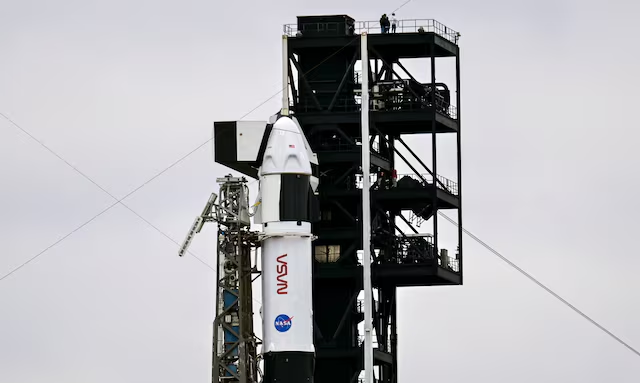
A SpaceX Falcon 9 rocket lifted off from Florida early Friday, carrying the Crew-12 mission to the International Space Station (ISS). Specifically, the crew includes two NASA astronauts, one French astronaut from the European Space Agency, and one Russian cosmonaut. Together, they will spend eight months conducting scientific research in Earth orbit.
The launch occurred at 5:15 a.m. EST from Cape Canaveral Space Force Station. During the event, a live NASA-SpaceX webcast showed the 25-story-tall rocket rising as its nine Merlin engines ignited. As it ascended, the engines consumed 700,000 gallons of fuel per second, lighting up the predawn sky with vapor clouds and a reddish fireball.
The Crew Dragon capsule, named Freedom, operates autonomously. Accordingly, it will dock with the ISS on Saturday afternoon—about 34 hours after liftoff—at an altitude of roughly 250 miles (420 km) above Earth.
This flight marks the 12th long-duration ISS mission that NASA has flown with SpaceX since May 2020. Originally, U.S. crewed launches relied on the Space Shuttle, which retired in 2011. However, after a nine-year gap, SpaceX restored American access to orbit through its commercial partnership with NASA.
The Crew-12 mission is led by Jessica Meir, 48, a veteran NASA astronaut and marine biologist. Notably, this is her second trip to the ISS. Nearly seven years ago, she made history with Christina Koch by completing the first all-female spacewalk.
She is joined by Jack Hathaway, 43, a former U.S. Navy fighter pilot and first-time astronaut. Additionally, Sophie Adenot, 43—a French helicopter pilot and ESA astronaut—is on board. Rounding out the international team is Russian cosmonaut Andrey Fedyaev, a former military pilot on his second ISS mission.
Upon arrival, the crew will begin a rigorous schedule of scientific work. According to NASA, their tasks include studying pneumonia-causing bacteria to improve treatments on Earth. Moreover, they will test interactions between plants and nitrogen-fixing microbes—research aimed at boosting food production during future deep-space missions.
The Crew-12 mission will be welcomed by three current ISS residents: NASA astronaut Chris Williams and Roscosmos cosmonauts Sergey Kud-Sverchkov and Sergei Mikaev. Importantly, this handover follows an unexpected disruption.
Earlier this year, the previous crew—Crew-11—departed weeks ahead of schedule. In mid-January, one member required emergency medical evacuation due to an undisclosed serious health issue. Consequently, NASA and SpaceX executed an unprecedented early return flight.
The ISS, about the size of a football field, remains the largest human-made object in space. For over 25 years, it has operated continuously under a U.S.-Russian-led partnership that includes Canada, Japan, and 11 European nations.
Originally conceived to strengthen ties between Washington and Moscow after the Cold War, the station symbolizes decades of peaceful cooperation. Today, it serves as a floating laboratory for global science. Looking ahead, NASA has committed to maintaining operations until the end of 2030. Thus, the Crew-12 mission plays a vital role in sustaining that legacy through science, diplomacy, and exploration
READ: Norwegian Air Rejects Starlink Wi-Fi Over Cost and Revenue Concerns