
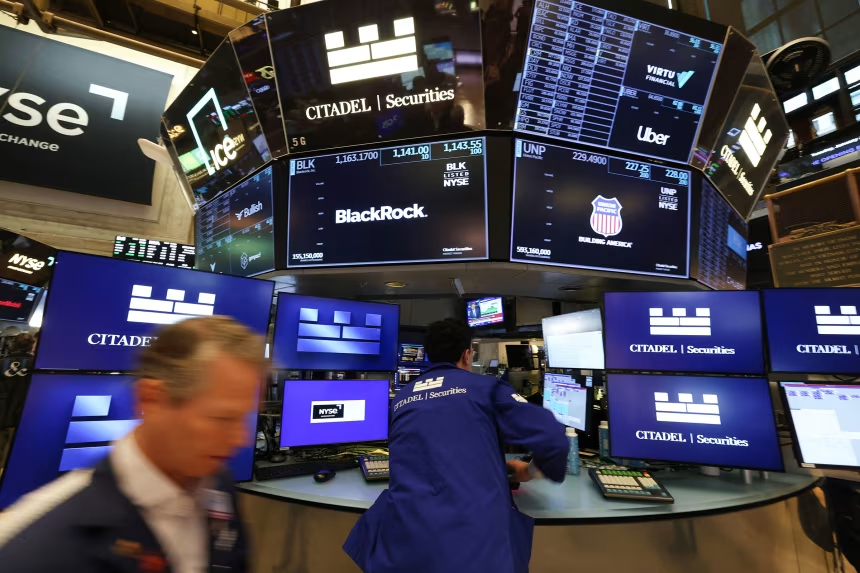
After a tumultuous start to the week, US stocks rebounded sharply, marking the S&P 500’s best day since November 2025. The rally came as President Donald Trump softened his confrontational stance regarding Greenland, signaling that he would not follow through with his previously threatened tariffs on European imports. This sudden change in tone provided a much-needed reprieve for global markets, which had suffered substantial losses following Trump’s earlier remarks about acquiring Greenland and the potential imposition of tariffs.
The Market’s Reversal: From Worst Day to Best Day
The market’s dramatic turn-around is a testament to the volatile nature of today’s political climate and the growing influence of presidential rhetoric on financial markets. Just a day after suffering its worst day since October 2025, the S&P 500 reversed course and finished the day with solid gains. The Dow Jones Industrial Average surged by 589 points (1.21%), while the S&P 500 climbed 1.16%, marking its best performance since late November. The tech-heavy Nasdaq also saw a substantial gain, rising 1.18%, its best day in over a month.
The shift in market sentiment came after Trump posted a message on social media indicating that he had held a “productive meeting” with NATO Secretary-General Mark Rutte and would not impose tariffs on European countries, as previously threatened. This announcement provided much-needed clarity to investors, sparking a wave of buying activity across US stocks.
The rally was especially significant given the market’s sharp decline on Tuesday, which had been fueled by concerns over Trump’s rhetoric and the potential for escalating trade tensions. Analysts had predicted that Trump might back down from his more aggressive stance, and his change in tone appeared to confirm those expectations.
The Role of “TACO” in Market Movements
The reversal in market sentiment on Wednesday was met with a mixture of relief and skepticism from investors. Wall Street quickly seized on the shift in Trump’s tone, with some analysts referring to it as “TACO Wednesday”—a nod to the popular market trade known as “Trump Always Chickens Out” (TACO). This trade refers to the market’s belief that President Trump often softens his policies when faced with significant market turmoil, as he did in previous trade conflicts, such as with China.
The TACO trade has become a common refrain among investors who believe that Trump’s market-driven decisions are influenced by his desire to avoid destabilizing the economy. As Ethan Harris, former head of global economics at Bank of America, pointed out, “The markets have learned that these corrections don’t last, therefore, no reason to panic.” His statement highlights the confidence investors have in the idea that, when necessary, Trump will recalibrate his policies to mitigate market disruption, as he has done in the past.
While Trump’s policy shifts can create short-term volatility, investors generally expect that these disruptions won’t persist long enough to cause lasting damage. This belief was evident in the immediate rally that followed Trump’s reversal.
Market Turmoil and the Bond Market’s Role
Before Trump’s change of tone, the financial markets were experiencing heightened volatility. The “Sell America” trade, which had investors dumping US stocks, bonds, and the dollar, was in full swing. The sharp declines were driven by fears that Trump’s confrontation with Europe over Greenland and tariffs would escalate into a full-blown trade war, destabilizing the US economy.
The sell-off had significant implications for the US bond market, which saw Treasury yields spike to their highest levels since September 2025. Treasury yields, which rise when bond prices fall, play a crucial role in setting borrowing costs for the US government, businesses, and consumers. A sustained rise in yields could have led to higher borrowing costs across the economy, making it more expensive for businesses and consumers to borrow money. This would have been a major concern for the market, as rising borrowing costs could have led to a slowdown in economic activity.
The bond market’s response to Trump’s tariffs also provided a key signal for whether the president would reconsider his stance. As Neil Wilson, a strategist at Saxo Markets, noted, “The only thing stronger and more intimidating than Trump is the US bond market.” This statement underscores the significant role that the bond market plays in shaping economic policy decisions. The recent rise in Treasury yields may have played a role in prompting Trump to reconsider his approach to Greenland, as the potential consequences for the economy became more evident.
TATA: A New Perspective on Trump’s Policies
While the “TACO” trade remains popular among Wall Street analysts, some have begun to shift their focus to a different interpretation of Trump’s policies: “Trump Always Tries Again” (TATA). According to this new perspective, Trump’s policy reversals are not necessarily signs of weakness, but rather part of a broader strategy to pause and reconsider policies before ultimately pursuing his original goals.
In line with this interpretation, Trump’s recent reversal on Greenland and the tariffs could be seen as a temporary de-escalation designed to calm markets before returning to his more aggressive stance on foreign policy and trade. Karl Schamotta, chief market strategist at Corpay, noted that while Trump’s reversal could help stabilize the dollar and ease short-term volatility, the incident served as a reminder of the unpredictable nature of US policy. “The episode has nonetheless reminded investors of the erratic nature of the current US policy regime,” Schamotta said, highlighting the continued uncertainty in global markets.
The Broader Implications for Global Markets
While Trump’s change in tone provided relief to US investors, the global implications of the dispute over Greenland remain uncertain. European countries hold approximately $8 trillion worth of US stocks and bonds, making them key players in the US financial system. A sell-off in US Treasuries could have far-reaching effects on both the US and global economies, potentially driving up borrowing costs and causing further volatility in the markets.
Furthermore, Europe has its own economic power to wield. The EU could implement its “trade bazooka”—a suite of trade measures designed to counter US policies—which could negatively impact US businesses, particularly big tech firms that have driven much of the recent market growth. However, as Trump and Rutte’s meeting demonstrated, the situation is far from settled, and it is unclear what further measures will be necessary to resolve the Greenland dispute.
A Temporary Reversal or Long-Term Shift?
While the market rally following Trump’s softer tone on Greenland offers immediate relief, the broader implications of his policies remain uncertain. Trump’s tendency to soften his approach when faced with market volatility has become a well-known pattern, and investors are likely to remain on edge, awaiting the next shift in his rhetoric and policy.
As the situation unfolds, the key question is whether Trump’s recent reversal is merely a temporary de-escalation or part of a broader strategy to balance his confrontational stance with the need to maintain market stability. For now, markets are cautiously optimistic, but the unpredictability of US foreign policy continues to cast a shadow over global financial markets, leaving investors to brace for further developments in the coming months.


