
Artificial intelligence and machine learning are at the heart of today’s technological revolution. From healthcare to finance, businesses are integrating AI into their operations, creating huge demand for professionals skilled in data science, neural networks, and automation. The best free AI and machine learning courses provide high-quality education from leading universities and tech companies, helping learners build expertise without financial barriers.
Google AI: Machine Learning Crash Course
Google AI’s Machine Learning Crash Course is one of the most practical introductions to machine learning. It offers over 25 lessons, real-world exercises, and video lectures by Google researchers. Learners explore core concepts like linear regression, classification, and neural networks through TensorFlow tutorials. The course combines theory with interactive coding exercises, making it an excellent starting point for beginners and professionals seeking to strengthen foundational ML skills.
Coursera: AI for Everyone by Andrew Ng
Created by Andrew Ng, one of the pioneers of AI education, AI for Everyone on Coursera is designed for non-technical learners. The course explains how AI impacts businesses, the economy, and society. It focuses on understanding what AI can and cannot do, helping professionals in management, marketing, and policy make informed decisions about AI adoption. Coursera also offers free auditing options, allowing learners to access all materials without certification fees.
edX: Machine Learning Fundamentals by UC San Diego
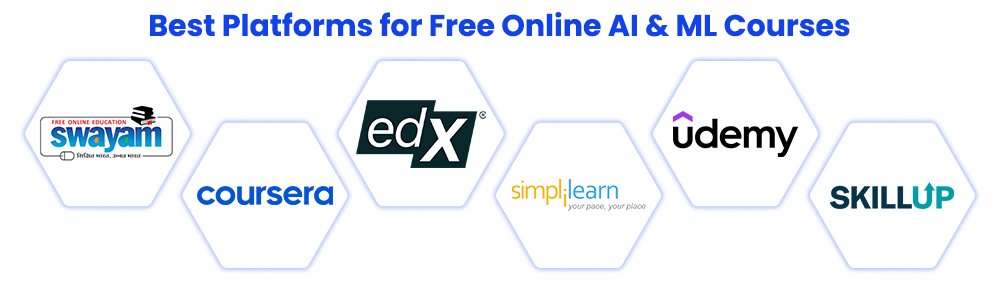
edX, in partnership with the University of California, San Diego, provides a free Machine Learning Fundamentals course that blends mathematics, algorithms, and Python programming. It introduces supervised and unsupervised learning, model evaluation, and feature engineering. Learners gain a clear understanding of how algorithms work and how they’re applied in real-world scenarios. The free audit mode gives access to all course content, making it a valuable resource for beginners.
Kaggle Learn: Practical Machine Learning Tutorials
Kaggle Learn is a favorite among data scientists because it focuses on hands-on practice. The platform offers short, practical tutorials like Intro to Machine Learning, Intermediate ML, and Deep Learning. Each module includes real coding challenges using real-world datasets. Kaggle’s integration with Jupyter notebooks allows learners to experiment with code directly in the browser, providing an authentic, project-based learning experience.
IBM: Introduction to Artificial Intelligence (Coursera)
IBM’s Introduction to AI course on Coursera gives a comprehensive overview of AI principles, applications, and ethical considerations. It’s free to audit and suitable for beginners. Learners explore how AI systems like natural language processing and computer vision work in real life. IBM’s hands-on exercises reinforce understanding and help learners visualize how machine learning models operate.
Microsoft Learn: AI Fundamentals
Microsoft Learn’s AI Fundamentals course offers free, self-paced modules covering AI concepts, machine learning models, and responsible AI principles. It introduces tools like Azure AI Services and Cognitive APIs, making it practical for those interested in deploying AI solutions. The course includes interactive labs and prepares learners for the Microsoft Certified AI Fundamentals (AI-900) exam.
Stanford University: Machine Learning (by Andrew Ng)
Stanford University’s Machine Learning course, also led by Andrew Ng, remains one of the most popular free courses ever created. Hosted on Coursera, it delves into supervised learning, unsupervised learning, neural networks, and reinforcement learning. While a paid certificate is optional, learners can freely access all video lectures, assignments, and quizzes. This course provides deep theoretical knowledge suitable for anyone pursuing a career in data science or AI research.
Harvard University: CS50’s Introduction to Artificial Intelligence with Python
Harvard’s CS50 AI course is available free on edX and focuses on building AI systems using Python. It explores key areas like search algorithms, machine learning, neural networks, and natural language processing. Learners develop practical programming skills while understanding the ethical dimensions of AI. Harvard’s structured teaching style ensures clear comprehension even for those new to computer science.
Fast.ai: Practical Deep Learning for Coders
Fast.ai offers one of the most hands-on deep learning courses available online. It teaches learners how to train models using PyTorch without needing advanced math. Students work on image classification, natural language processing, and recommendation systems from the start. The course emphasizes real-world application and provides an open-source learning experience for developers and researchers.
MIT OpenCourseWare: Deep Learning for Self-Driving Cars
MIT’s Deep Learning for Self-Driving Cars is a free, advanced-level course that explores how AI powers autonomous vehicle systems. Learners dive into convolutional neural networks, reinforcement learning, and sensor fusion. The course’s lecture videos and assignments are available through MIT OpenCourseWare, providing access to university-grade materials at no cost.
Elements of AI by Reaktor and the University of Helsinki
Elements of AI is a widely acclaimed free course designed to make AI accessible to everyone. It blends theory and practical exercises, helping learners understand AI’s societal and ethical implications. The program has reached millions of learners globally and is available in multiple languages. It’s an ideal choice for beginners curious about how AI works without diving into complex coding.
Why You Should Learn AI and Machine Learning
Learning AI and machine learning opens doors to countless career opportunities across industries. These fields power innovations in automation, finance, healthcare, and robotics. Free online courses make it possible for anyone to start building a career in AI without paying tuition fees. With dedication and curiosity, learners can progress from understanding the basics to mastering advanced algorithms—all from the comfort of their own homes.