In a major strategic realignment, General Motors (GM) has announced that it will take a $7.1 billion charge in the fourth quarter of 2025 as the company shifts its focus from electric vehicles (EVs) to internal combustion engine (ICE) vehicles. This move comes as GM grapples with slower-than-expected EV adoption, evolving market conditions, and regulatory changes.
The charges, which amount to $6 billion related to GM’s EV business in North America and an additional $1.1 billion linked to restructuring its China joint venture, signal a significant pivot in the company’s approach to future vehicle production.
GM’s Realignment: Shifting Toward Full-Size Trucks and SUVs
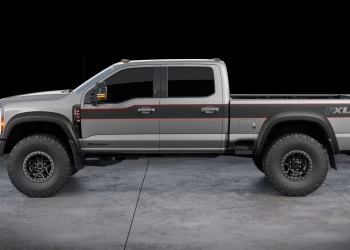
The announcement highlights GM’s plan to scale back its EV production capacity in favor of manufacturing more full-size trucks and SUVs. These vehicles, which are traditionally powered by internal combustion engines, continue to be highly popular among consumers, especially in the U.S. The company has already begun transitioning its Orion, Michigan plant, which was initially set to produce electric vehicles, to instead focus on ICE-powered full-size pickups and SUVs.
According to GM’s statement, this strategic move is designed to meet the unmet demand for these vehicles, which have proven more resilient in terms of consumer demand, especially as adoption rates for electric vehicles have slowed.
While the shift will have short-term implications, GM remains committed to electric vehicles in the long run, and the company will continue to produce existing EV models, including the Chevrolet Equinox EV, GMC Silverado EV, and Cadillac Lyriq SUV. However, it’s clear that the company is scaling back its EV ambitions in the near term as it focuses on more profitable models with higher demand.
The $6 Billion EV Charge: A Closer Look
A breakdown of GM’s $6 billion charge reveals several key components:
- $1.8 billion non-cash write-down: This represents the devaluation of GM’s EV manufacturing assets as the company reassesses the viability of its electric vehicle strategy.
- $4.2 billion in costs related to supplier contracts: The charges include the costs associated with settling contracts, particularly battery supply deals, that were originally made as part of GM’s aggressive push into the EV market.
While these adjustments will undoubtedly have an impact on GM’s financial performance in the short term, the company sees it as a necessary step in realigning its strategy to address the current market conditions.
Employment Impact: Job Cuts and Temporary Layoffs
In addition to the financial charges, GM has also announced job cuts and temporary layoffs across its key facilities. The company will cut approximately 3,400 jobs at its EV and battery plants, including positions at Factory Zero (formerly Detroit-Hamtramck Assembly) and its Ultium Cells battery plant in Warren, Ohio. These layoffs, effective January 5, 2026, reflect the reduction in EV production capacity.
Despite these cuts, GM has reassured employees that those affected by temporary layoffs will receive a portion of their wages and benefits while the company restructures its operations. The company is also working to ensure that these transitions are handled as smoothly as possible for those affected.
Regulatory Changes and the Impact on EV Demand
Several factors have contributed to GM’s decision to scale back its EV production. One of the key influences has been the termination of the $7,500 EV tax credit under the Trump administration, which had previously incentivized consumers to purchase electric vehicles. With the removal of these incentives, consumer demand for EVs has slowed significantly.
Additionally, the reduction in stringent emissions regulations has made it easier for automakers to continue producing traditional vehicles with internal combustion engines, which have historically been more profitable. As the regulatory landscape continues to evolve, GM’s strategy appears to be shifting to align with the realities of the current market.
GM’s Strategy Moving Forward: Balancing EVs and ICE Vehicles
While GM is pulling back on its immediate EV plans, it continues to prioritize a long-term strategy focused on innovation and sustainability. The company has already committed to becoming carbon-neutral by 2040 and will continue investing in electric vehicle technologies. However, the near-term focus will be on meeting consumer demand for internal combustion engine vehicles, which remain a significant part of the global automotive market.
This shift in strategy is part of a broader trend in the automotive industry, with other companies like Ford also re-evaluating their electric vehicle plans. In December 2025, Ford announced a similar move, adjusting its electrification strategy in response to slower EV adoption and shifting market dynamics.
What Does This Mean for Consumers and the Automotive Industry?
For consumers, GM’s strategy shift means that full-size trucks and SUVs will continue to dominate the market in the short term, while EV offerings may be reduced or adjusted. This could lead to more affordable options in the ICE vehicle segment, but it also signals a delay in the widespread adoption of electric vehicles, especially in the U.S.
For the automotive industry, GM’s adjustments underscore the complexities of the transition to electric vehicles. While the future of the auto industry remains electric, the path to full electrification will take time, and automakers must balance regulatory pressures, consumer demand, and the profitability of their product lines.
The Long-Term Outlook for GM
In the long run, GM’s focus on scaling back its EV capacity will likely allow the company to remain competitive in the U.S. market, where ICE vehicles still hold a dominant share. At the same time, GM’s commitment to electric vehicles and sustainable practices will ensure that it remains well-positioned for future growth in the EV sector as consumer demand picks up again and new technologies are developed.
The company’s realignment also signals the importance of flexible operations in the face of rapidly changing market conditions. By adjusting its strategy to the realities of EV adoption and regulatory changes, GM is setting itself up for resilience and long-term success in both the ICE and EV markets.