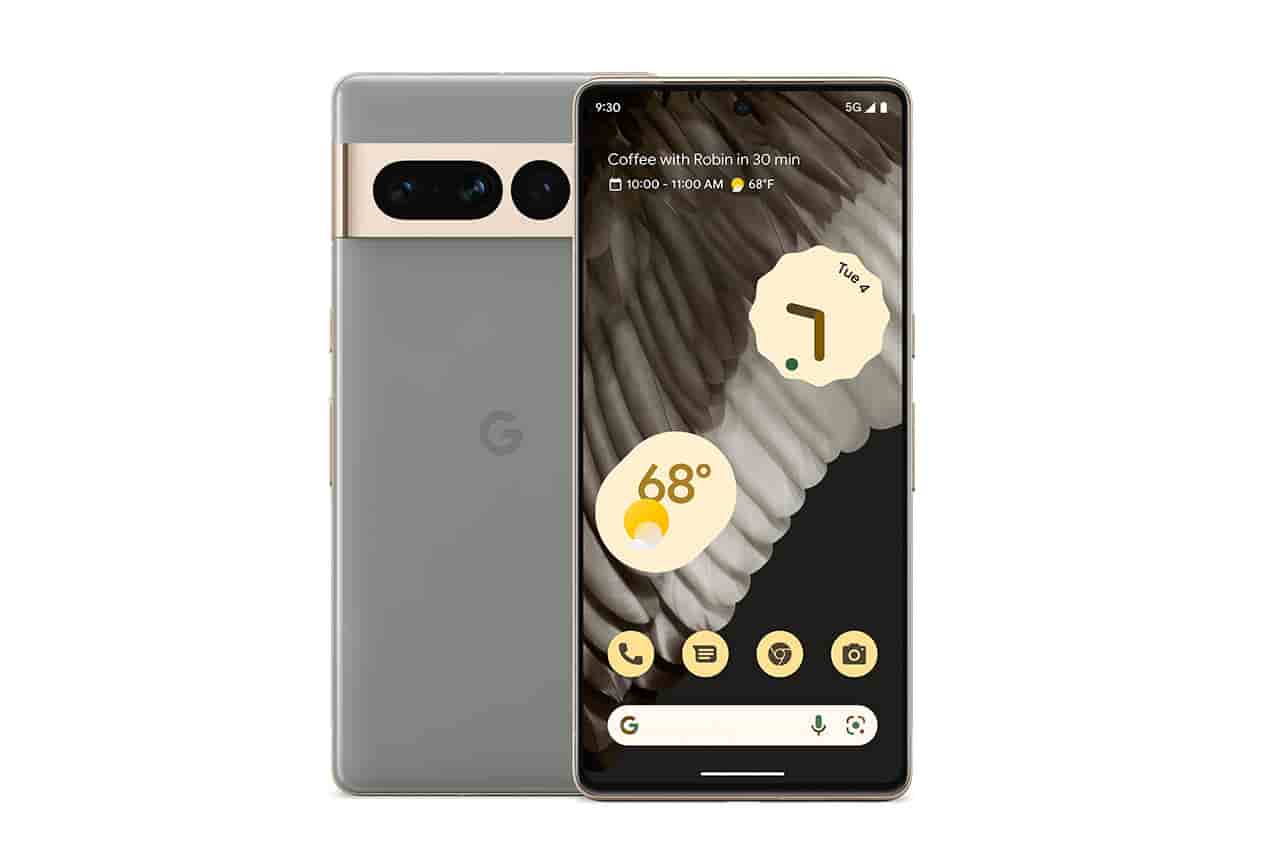
The Google Pixel 7 Pro, released in October 2022, represented the pinnacle of Google’s smartphone innovation at the time, blending AI-driven performance, advanced camera technology, and premium design into one cohesive flagship. Building upon the foundation laid by the Pixel 6 Pro, the Pixel 7 Pro refined every detail — from its polished aluminum frame to its next-generation Tensor G2 processor and professional-grade triple camera system. It showcased Google’s growing mastery of hardware-software integration, combining raw computational power with intuitive Android intelligence.
Additionally, the Pixel 7 Pro ran Android 13 out of the box and was promised up to five years of major updates, ensuring long-term reliability. Its expansive 6.7-inch LTPO AMOLED display with 120Hz refresh rate and HDR10+ certification provided a stunning visual experience with up to 1500 nits of peak brightness. Designed for those who expect excellence in performance, imaging, and endurance, the Pixel 7 Pro cemented its place as Google’s most polished flagship of the year.
Google Pixel 7 Pro Full Phone Specifications
| Category | Specification |
|---|---|
| Launch | Announced October 6, 2022; Released October 13, 2022 |
| Status | Available |
| Network | GSM / CDMA / HSPA / EVDO / LTE / 5G |
| Body Dimensions | 162.9 x 76.6 x 8.9 mm (6.41 x 3.02 x 0.35 in) |
| Weight | 212 g (7.48 oz) |
| Build | Glass front (Gorilla Glass Victus), glass back (Gorilla Glass Victus), aluminum frame |
| SIM | Nano-SIM + eSIM |
| Water Resistance | IP68 dust/water resistant (up to 1.5m for 30 min) |
| Display Type | LTPO AMOLED, 120Hz, HDR10+, 1000 nits (HBM), 1500 nits (peak) |
| Display Size | 6.7 inches, 110.6 cm² (~88.7% screen-to-body ratio) |
| Resolution | 1440 x 3120 pixels, 19.5:9 ratio (~512 ppi density) |
| Protection | Corning Gorilla Glass Victus |
| OS | Android 13, upgradable to Android 15 (5 years of major updates) |
| Chipset | Google Tensor G2 (5 nm) |
| CPU | Octa-core (2×2.85 GHz Cortex-X1 & 2×2.35 GHz Cortex-A78 & 4×1.80 GHz Cortex-A55) |
| GPU | Mali-G710 MP7 |
| Internal Storage | 128GB/256GB/512GB UFS 3.1 |
| RAM Options | 8GB or 12GB |
| Card Slot | No |
| Main Camera | Triple: 50 MP (wide) + 48 MP (telephoto, 5x optical zoom) + 12 MP (ultrawide) |
| Camera Features | Laser AF, Dual-LED flash, Pixel Shift, Auto-HDR, panorama |
| Video | 4K@30/60fps, 1080p@30/60/120/240fps; gyro-EIS, OIS, 10-bit HDR |
| Selfie Camera | 10.8 MP, f/2.2, 21mm (ultrawide), 1.22µm |
| Selfie Features | HDR, panorama |
| Video | 4K@30/60fps, 1080p@30/60fps |
| Sound | Stereo speakers, no 3.5mm headphone jack |
| Connectivity | Wi-Fi 802.11 a/b/g/n/ac/6e, Bluetooth 5.2, GPS, GLONASS, BDS, GALILEO, QZSS, NFC, USB Type-C 3.2 |
| Special Feature | Ultra Wideband (UWB) support |
| Sensors | Fingerprint (under display, optical), accelerometer, gyro, proximity, compass, barometer |
| Battery | Li-Ion 5000 mAh, non-removable |
| Charging | 23W wired (PD3.0, 50% in 30 min), 23W wireless, reverse wireless |
| Colors | Obsidian, Snow, Hazel |
| Models | GP4BC, GE2AE, GFE4J |
| Price | $209.90 / €289 / £238 / ₹35,980 |
| Performance Tests | AnTuTu: 796,369 (v9), GeekBench: 3187 (v5.1), GFXBench: 34fps (ES 3.1 onscreen) |
| Display Brightness | 1090 nits max brightness (measured) |
| Battery Life | Endurance rating: 83h |
Camera
The Google Pixel 7 Pro set new standards for smartphone photography with its triple-lens system and Google’s computational photography. The 50MP main sensor captured vibrant, detailed photos with excellent dynamic range, while the 48MP telephoto lens offered 5x optical zoom and up to 30x Super Res Zoom without significant loss in quality. The 12MP ultrawide lens included autofocus, doubling as a macro camera for detailed close-ups.
Enhanced by Tensor G2’s AI-powered image processing, the camera introduced features such as Cinematic Blur, Photo Unblur, and Real Tone, delivering true-to-life skin tones and refined textures. The HDR+ engine and 10-bit HDR video recording elevated color depth and brightness accuracy, while OIS and EIS ensured smooth, stable footage. The 10.8MP selfie camera maintained high detail and supported 4K recording, ideal for creators and professionals.
Design and Display
The Pixel 7 Pro refined its predecessor’s aesthetics, combining elegance with durability. Its polished aluminum camera bar seamlessly integrated into the chassis, emphasizing Google’s unique design language. The use of Corning Gorilla Glass Victus on both sides ensured scratch resistance and resilience against drops. The phone’s curved edges provided a comfortable grip, while color options like Hazel, Snow, and Obsidian projected sophistication and modern appeal.
The 6.7-inch LTPO AMOLED display delivered one of the most dynamic viewing experiences available. Supporting HDR10+ and up to 1500 nits of peak brightness, it produced lifelike colors and exceptional clarity in all lighting conditions. Its adaptive 120Hz refresh rate automatically adjusted to optimize smoothness and battery efficiency. With a 1440 x 3120 resolution and 512 ppi density, the Pixel 7 Pro’s screen was both immersive and sharp, suitable for everything from gaming to media editing.
Performance
Powered by the Google Tensor G2, the Pixel 7 Pro excelled in both performance and intelligence. The chipset integrated advanced AI cores to improve speech recognition, photo processing, and on-device learning. Combined with 8GB or 12GB of RAM, it offered smooth multitasking, fast app switching, and superior gaming performance. The Mali-G710 GPU delivered up to 20% better graphics efficiency compared to the first Tensor chip.
Running Android 13, the device featured Material You design, live translation, adaptive display tuning, and enhanced security layers from Google’s Titan M2 coprocessor. It handled demanding workloads while maintaining temperature stability. Importantly, Tensor G2 optimized machine learning operations such as voice commands, real-time translation, and assistant responses, redefining what smart performance meant in a flagship.
Battery and Charging
With a 5000mAh battery, the Pixel 7 Pro was engineered for endurance. It easily provided a full day of moderate to heavy use. The 23W fast charging replenished 50% in about 30 minutes, while 23W wireless and reverse wireless charging added flexibility. Adaptive Battery technology extended longevity by learning usage habits and minimizing unnecessary background drain. Together with the LTPO display’s efficiency, it ensured reliable battery life even during intensive use.
Durability
The Google Pixel 7 Pro maintained a robust build, combining Gorilla Glass Victus protection with an IP68 rating, making it resistant to dust and immersion in water. The aluminum frame added structural strength, and the under-display fingerprint sensor offered quick and secure authentication. With continuous software updates and security patches, Google ensured its flagship remained both durable and relevant for years.
In summary, the Google Pixel 7 Pro was a masterclass in design and intelligence. With its advanced Tensor G2 processor, professional camera system, immersive LTPO AMOLED display, and robust durability, it stood as one of the most complete Android flagships of 2022. Balancing performance, elegance, and innovation, it reinforced Google’s dominance in the premium smartphone category.