
The Iran Israel war escalation intensified on Monday as Israel confirmed plans for at least three more weeks of military operations while air strikes continued across multiple Iranian cities overnight. At the same time, Iranian drone attacks disrupted critical infrastructure in the Gulf region, including a key oil facility in the United Arab Emirates and fuel infrastructure near Dubai’s international airport.
The conflict, now entering its third week, has already triggered major disruptions to global energy supply routes. The closure of the Strait of Hormuz has halted traffic through one of the world’s most vital maritime corridors. Nearly twenty percent of global oil and liquefied natural gas shipments normally pass through the narrow waterway connecting the Persian Gulf to international markets.
As a result, oil prices have surged above one hundred dollars per barrel, raising concerns about a renewed wave of global inflation. Energy markets remain highly sensitive to any disruption in Gulf shipping routes because many of the world’s largest oil exporters depend on the strait to reach global buyers.
Israeli military officials say operations against Iran will continue in the coming weeks. Lieutenant Colonel Nadav Shoshani, a spokesperson for the Israeli military, said planners have prepared detailed operational plans covering at least the next three weeks of fighting. Military planners have also prepared additional strategies that extend further into the future.
According to Israeli officials, the military campaign focuses on weakening Iran’s ability to threaten Israel. The strategy includes targeting ballistic missile infrastructure, nuclear facilities, and security institutions linked to the Iranian state.
Israeli forces carried out overnight air strikes against several major Iranian cities. Military officials confirmed attacks on locations in Tehran, Shiraz, and Tabriz that they described as strategic infrastructure connected to Iran’s security apparatus.
Iranian media outlets reported significant casualties from the strikes. Mehr News Agency said attacks in Markazi province killed five people and injured seven others. The strikes hit locations near the city of Arak as well as residential areas in Mahallat county.
Additional damage occurred in Khomein city, where reports indicated that an Israeli strike hit a boys’ school. Authorities said the attack damaged surrounding structures but did not report any casualties at the school.
Rescue workers in Tehran continued searching for survivors after a strike destroyed a residential building. Emergency crews worked through the wreckage as rescue teams attempted to locate people trapped beneath the rubble.
A Red Crescent aid worker involved in the operation said teams were still pulling victims from the debris hours after the attack. The rescue operation remained active while authorities assessed the scale of the damage.
Residents inside Iran described growing fear and uncertainty as the conflict continued. Shahnaz, a sixty-two-year-old resident of Tehran, told reporters that communication disruptions left many people feeling isolated during the overnight strikes.
She said the internet shut down across large parts of the city during the attacks. The blackout prevented residents from contacting relatives or accessing news about the unfolding situation.
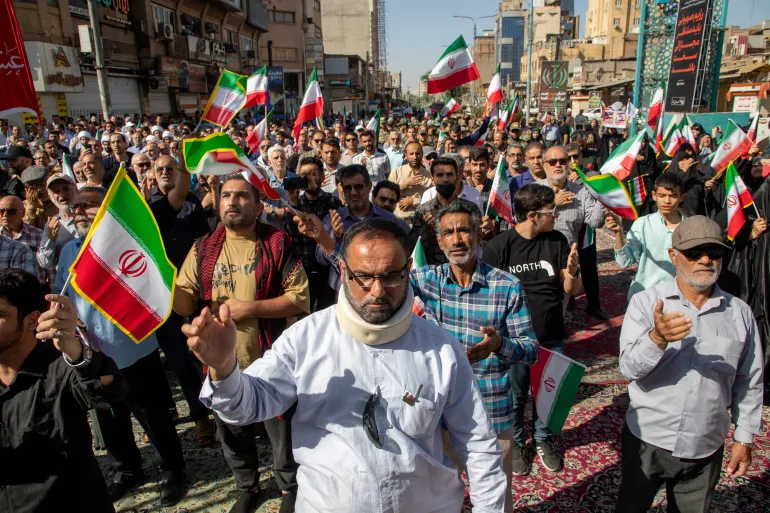
The strikes occurred just days before the Iranian New Year celebration known as Nowruz. Many residents normally prepare for the holiday with public gatherings and family events. However, the ongoing war has created an atmosphere of anxiety across the country.
While Israeli air strikes continued inside Iran, Tehran launched retaliatory attacks against several regional targets. Iran’s Revolutionary Guards announced missile and drone strikes aimed at multiple locations linked to Israel and the United States.
The attacks targeted areas in Tel Aviv as well as U.S. military facilities in the Gulf region. Iranian forces also struck the Al-Dhafra air base in Abu Dhabi and a U.S. naval installation in Bahrain.
Energy infrastructure also suffered damage during the escalation. Iranian drones struck the UAE port of Fujairah, forcing authorities to suspend oil loading operations at the facility.
The Fujairah terminal serves as a key export hub for Murban crude oil produced by the United Arab Emirates. The port normally handles volumes equivalent to roughly one percent of global oil demand.
Drone attacks also disrupted operations near Dubai International Airport. Authorities temporarily halted flights after a strike hit a nearby fuel storage facility, sending large plumes of smoke into the sky.
Regional air defence systems responded quickly to additional threats. Saudi Arabia reported intercepting thirty-four drones over its eastern region within a single hour. Officials said the attacks caused no injuries but highlighted the widening geographic scope of the conflict.
The Iran Israel war escalation has also triggered intense diplomatic activity among global leaders. U.S. President Donald Trump called for an international coalition to reopen the Strait of Hormuz and secure shipping routes in the region.
Trump warned that the NATO alliance could face serious consequences if member states refuse to assist the United States in protecting the vital shipping corridor.
However, several allied governments responded cautiously to the proposal. Many leaders expressed support for diplomatic efforts but signalled reluctance to join military operations against Iran.
British Prime Minister Keir Starmer said the United Kingdom would cooperate with international partners to reopen the strait. However, he emphasized that Britain would not participate in a broader war against Iran.
Japan also declined to send naval forces to the region. Australian officials announced they would contribute surveillance aircraft and missile systems to support the United Arab Emirates but ruled out deploying naval vessels.
Germany adopted an even clearer position. Defence Minister Boris Pistorius stated that Germany would not take part in military operations connected to the conflict.
Meanwhile, tensions surrounding the war have begun affecting broader geopolitical relationships. Trump suggested he may postpone a planned meeting with Chinese President Xi Jinping if Beijing refuses to help secure the Strait of Hormuz.
Chinese officials have not publicly responded to the request. However, global diplomatic efforts continue as governments attempt to prevent further escalation.
As fighting continues across multiple fronts, analysts warn that the Iran Israel war escalation could reshape global energy markets and security alliances. If the conflict expands or the Hormuz route remains closed for an extended period, the consequences for international trade and fuel prices could be severe.
For now, the conflict shows no sign of ending soon. Israeli officials say the military campaign will continue until Iran’s strategic capabilities suffer significant damage. Iran, meanwhile, has signalled it will continue retaliatory strikes as long as attacks persist.
The world now watches closely as the Middle East conflict threatens to push global energy markets and international diplomacy into an increasingly unstable phase.


