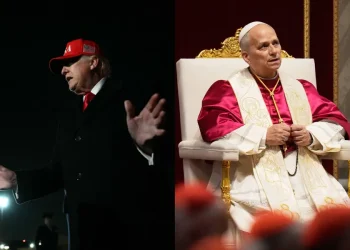
In a move that has already sparked intense geopolitical debate, U.S. President Donald Trump has declared Venezuela’s airspace “closed” to counter what he describes as escalating narcotics trafficking, human smuggling, and organized criminal activity linked to the Nicolás Maduro government. The announcement, delivered with characteristic bluntness, signals a new phase in Washington’s long-running confrontation with Caracas and adds fresh tension to an already volatile region.
A Direct Strike at Maduro’s Government
Trump’s declaration explicitly targets the Venezuelan state, which the U.S. has accused for years of enabling and participating in transnational criminal networks. His remarks revive the 2020 U.S. federal indictment of President Nicolás Maduro, who was charged alongside several high-ranking Venezuelan military and political figures for narco-terrorism, cocaine trafficking, corruption, and aiding foreign militant groups.
At the center of these allegations is the infamous “Cartel of the Suns,” a sprawling drug trafficking organization reportedly embedded within the Venezuelan armed forces. U.S. prosecutors say that for more than a decade, this cartel has worked with guerrilla groups, criminal syndicates, and corrupt state officials to transport vast quantities of cocaine into Central America, the Caribbean, and the United States.
Trump’s new order frames the airspace closure as an additional mechanism to choke off these networks. However, the specifics of how the United States intends to enforce such a closure—especially without violating international norms—remain unclear.
Supporters Praise a Hardline Stance
Several Republican lawmakers quickly voiced support for the president’s decision. Senator Lindsey Graham, one of Trump’s staunchest foreign-policy allies, called Venezuela under Maduro a “narcoterrorist state” that collaborates with global militant organizations, including Hezbollah. According to Graham and other supporters, Trump’s directive signals a needed willingness to confront a regime that they believe threatens U.S. national security and destabilizes the Western Hemisphere.
They argue that Venezuela’s failed economy, widespread corruption, and entrenched criminality have fueled not only drug trafficking but also mass migration, putting additional pressure on U.S. borders. To them, the airspace shutdown is another tool to curb these flows and force Maduro into compliance with international law.
Critics Warn of Escalation and Legal Gray Areas
Despite the strong backing from Trump’s supporters, critics say the move is deeply problematic and risks escalating an already fragile situation. Human rights groups and foreign policy analysts warn that closing a sovereign nation’s airspace without an international mandate could set a dangerous precedent.
Reports of U.S. military assets positioned in the Caribbean and along South America’s northern corridor have prompted concerns that the order could inadvertently lead to armed confrontation—or be used to justify more aggressive operations in Venezuelan territory.
Legal scholars also note that only recognized governments typically have the authority to close their own airspace. Since Maduro still controls Venezuela’s state institutions, including its military and aviation authority, Trump’s declaration functions more as a unilateral U.S. directive than an enforceable international rule.
No Downed Aircraft, No Clear Enforcement Strategy
Despite the tough rhetoric, there have been no reported attempts to shoot down or force land any aircraft over Venezuelan territory. Officials familiar with U.S. defense policy say that without explicit rules of engagement, the order risks creating confusion among military commanders and pilots assigned to monitor the region.
As of now, the Pentagon and Homeland Security have not released detailed operational guidelines. It remains uncertain whether the U.S. intends to interdict flights suspected of drug trafficking only in international airspace or whether enforcement could extend closer to Venezuelan borders.
A Continuation of Trump’s Broader Strategy
The airspace announcement aligns with Trump’s ongoing efforts to combat drug trafficking and reduce migration into the United States. Since reassuming the presidency, he has introduced a series of proposals aimed at curbing illegal crossings and strengthening border enforcement. Closing Venezuelan airspace, in his view, is part of a broader campaign to restrict the flow of drugs, weapons, and migrants routed through Latin America.
Foreign policy experts say the move should also be seen in the context of Trump’s long-standing antagonism toward Maduro. For years, Trump has pushed for stronger sanctions, international isolation, and covert pressure to weaken the Venezuelan president’s hold on power. By linking Maduro to narcoterrorist networks, Trump continues to portray Venezuela as not merely an ideological rival but as a direct threat to American security.
Uncertain Impact Amid a Shifting Geopolitical Landscape
While the directive has captured global headlines, analysts remain divided on whether it will significantly affect drug trafficking routes. Critics argue that trafficking organizations can adjust quickly, shifting shipments through Colombia, Guyana, Suriname, or maritime corridors in the Caribbean. Given Venezuela’s already limited control over its borders, the practical impact may be minimal unless paired with coordinated regional enforcement.
Diplomatic tensions, however, are almost certain to rise. Maduro’s government has condemned similar U.S. actions in the past, accusing Washington of imperialism and destabilizing tactics. A formal response from Caracas to Trump’s latest announcement is expected.
A High-Risk Gamble
As the situation unfolds, Trump’s declaration represents a bold—and potentially risky—foreign policy maneuver. It underscores Washington’s determination to pressure Venezuela but leaves major questions unanswered:
- How will the U.S. enforce the airspace closure without provoking conflict?
- Will the move meaningfully disrupt the drug networks it targets?
- Could this intensify humanitarian strain in a region already grappling with mass displacement?
- And what does the decision signal about future U.S. engagement in Latin America?
For now, the declaration stands as a stark new chapter in an already turbulent relationship between the United States and Venezuela, with implications that could ripple across the hemisphere.