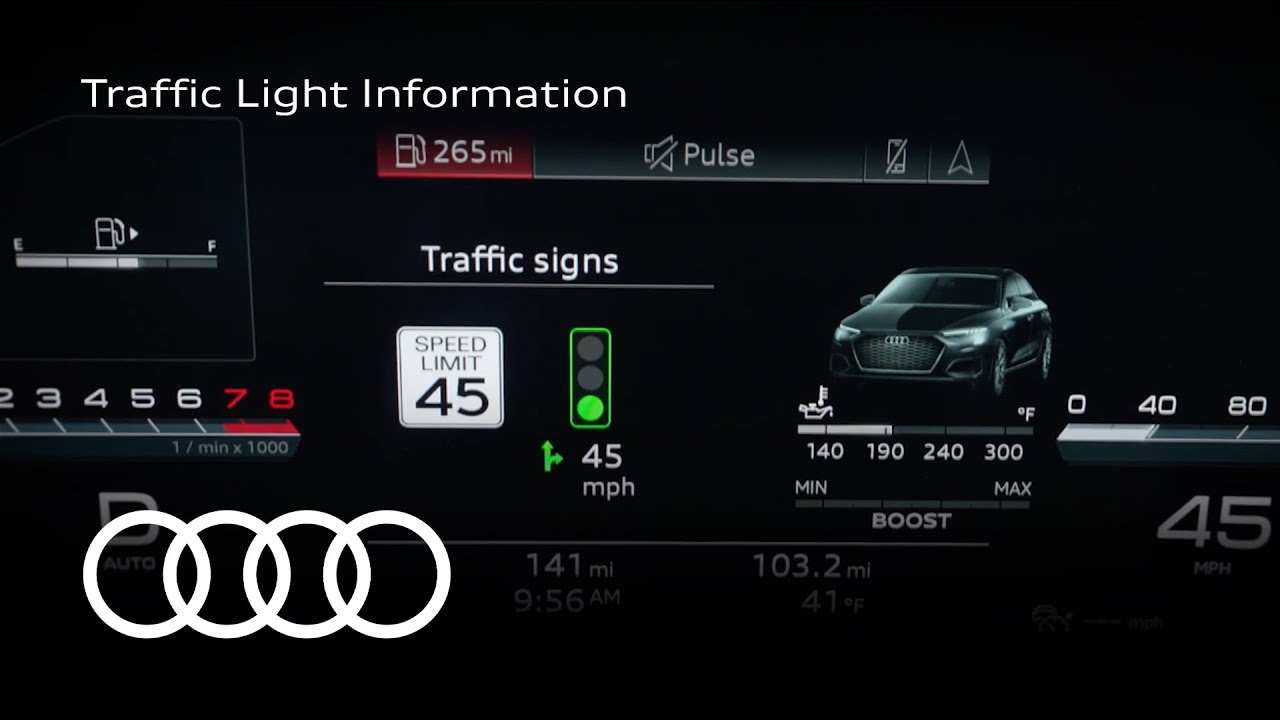
Audi is rolling out a new generation of driver-assistance technology that allows cars to detect red lights before the driver even notices them. By combining sensors, artificial intelligence and live communication with traffic infrastructure, the system gives drivers extra seconds to react, brake smoothly and avoid sudden, risky stops. As roads grow more complex and urban traffic gets denser, this kind of predictive assistance is becoming central to how carmakers think about safety, comfort and smart mobility. Audi views the feature as another step toward fully connected, semi-autonomous driving on city streets.
How Audi’s Early Red-Light Detection System Works
At the core of Audi’s technology is a tightly integrated network of cameras, radar units and control software. The car constantly scans the road ahead, reading lane markings, vehicles, road signs and, crucially, traffic lights. When the vehicle approaches an intersection, the system tracks the status of the light and estimates how long it will remain green. If the algorithms determine that the car’s speed will not allow it to pass safely, it issues an early alert to the driver.
In connected cities, the feature can also tap into vehicle-to-infrastructure communication. Traffic lights equipped with smart controllers broadcast their phase and timing information. The car receives this data, cross-checks it with its own sensor inputs and predicts when the light will turn red. This layered approach reduces errors and keeps the driver informed even when visibility is poor due to curves, trucks or bad weather.
Enhancing Safety at High-Risk Intersections
Intersections are among the most dangerous locations on any road network. Many collisions happen because drivers misjudge distance, react late or are briefly distracted. Audi’s red-light detection system directly targets this risk zone. By giving a clear, early warning, it encourages smoother deceleration and reduces the need for last-second braking.
The system can also work with other safety features already present in the vehicle. When the car anticipates a red light, adaptive cruise control adjusts speed earlier. Forward-collision warnings remain active but trigger less frequently because the driver has more time to respond. Over time, this kind of anticipatory assistance can reduce fatigue, making city driving feel calmer and more predictable.
Role of Artificial Intelligence and Data Processing
Artificial intelligence sits at the heart of the new feature. Instead of relying on fixed rules, Audi’s software analyses patterns in real time. It evaluates the distance to the intersection, current speed, road conditions and the behaviour of nearby vehicles. Then it calculates optimal timing for alerts and, when enabled, for automated speed adjustment.
The system must also handle ambiguous scenarios. For example, multiple traffic lights might be visible at once, especially in complex junctions. AI helps determine which light applies to the car’s lane and direction. Machine-learning models improve over time as they encounter more real-world situations. This learning process allows the system to refine its predictions and reduce false warnings.
Benefits for Drivers and Urban Mobility
From the driver’s perspective, the biggest benefit is smoother, more confident driving. Knowing that the car can “see” an upcoming red light and warn in advance reduces stress, particularly in unfamiliar cities or during night driving. The vehicle encourages earlier braking, which improves passenger comfort and reduces wear on brakes and tyres.
Cities can also benefit. When many connected cars adjust speed in harmony with traffic signals, stop-and-go driving decreases. This leads to lower fuel consumption for combustion vehicles and improved range for electric cars. It can also reduce noise and emissions in dense urban areas. Over the long term, widespread adoption of such systems may help traffic engineers fine-tune signal timing based on real driving patterns.
Building Blocks for Future Autonomous Functions
Audi’s red-light detection technology is not a full self-driving system, yet it establishes important foundations. Vehicles that can accurately interpret traffic signals and communicate with infrastructure are better prepared for more advanced automation. In future updates, similar systems could coordinate with automatic lane-keeping and advanced cruise control to handle more of the driving task in slow city traffic.
The same sensor and communication framework can support additional features. For example, cars might receive recommended speeds that let them “ride the green wave” and hit a series of green lights without stopping. They could also receive warnings about temporary road closures or emergency vehicles approaching an intersection. Each new function builds on the same digital link between the car and the city around it.
Challenges and Limitations of the Technology
Despite its promise, the technology faces several challenges. It works best in areas where traffic lights and road infrastructure are modern and well mapped. In older districts or rural regions with limited connectivity, the system must rely entirely on onboard sensors. Harsh lighting, damaged signal heads or heavy rain can make visual detection more difficult.
Standardisation is another issue. Different cities and countries use diverse communication protocols for smart infrastructure. Carmakers and public authorities need to agree on compatible standards so that cars can trust the data they receive. Privacy and security also matter. Systems must ensure that external signals cannot be manipulated by malicious actors who might want to disrupt traffic flow.
What This Means for the Future of Driving
Audi’s new red-light detection technology illustrates how quickly driving is moving from reactive to predictive. Cars are no longer just responding to what the driver does in the moment; they are constantly scanning ahead, modelling the environment and preparing for what comes next. This change reshapes how drivers experience the road and how cities think about transport design.
As more manufacturers adopt similar systems, drivers will start to expect early warnings, smoother traffic flow and a more intelligent relationship between vehicles and infrastructure. Over time, the line between driver assistance and partial automation will blur. The journey toward fully connected, safer and smarter mobility will likely pass through many such incremental innovations, and Audi’s red-light detection system is one of the clearest signs of where the industry is heading.