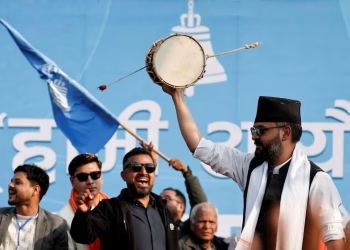
On November 15, 2025, the Orange Democratic Movement (ODM) celebrated its 20th anniversary in Mombasa, marking two decades of political activity in Kenya. However, the event that should have been a celebration of the party’s achievements instead unveiled growing divisions within its ranks. These divisions were particularly evident regarding the future leadership of the party and its position within the broader coalition with President William Ruto’s administration. In the wake of the untimely death of Raila Odinga on October 15, ODM is grappling with leadership uncertainties, and the 20th anniversary event highlighted these challenges publicly.
During the anniversary, Winnie Odinga, the daughter of the late Raila Odinga, publicly called for a National Delegates Conference (NDC) to decide who will lead ODM in the post-Raila era. She argued that this conference was necessary to select new leadership capable of managing the party’s coalition role with President Ruto’s administration. Oburu Odinga, who assumed the interim leadership role after Raila’s death, responded by pledging to continue Raila’s vision until 2027. However, his remarks didn’t resolve the growing tensions within the party. Regional leaders, including Babu Owino and key figures from the Coast region, spoke out about broader economic and leadership disagreements that have been simmering within ODM for years.
This article will dive deep into the key moments from the 20th anniversary celebrations, examine the leadership challenges ODM is facing, and explore what these internal divisions mean for the party’s future role in Kenyan politics.
Winnie Odinga’s Call for Leadership Change
Winnie Odinga’s speech during the 20th anniversary celebration was the focal point of the event. She called for a National Delegates Conference to select new leadership for the party. Winnie’s proposal was not just about choosing new leaders; it was a call for change in how ODM should approach its role in the coalition government with President Ruto. Winnie pointed out that current leadership had not fully embraced the changing political landscape following her father’s passing. She suggested that without a fresh perspective, ODM could lose its relevance both in the coalition and in Kenyan politics at large.
Her comments were a reflection of the frustrations brewing within certain factions of the party. Some members feel that the party needs new energy and new ideas to navigate the political challenges ahead. For them, continuing under the leadership of figures like Oburu Odinga—who has taken a more conservative approach—will not be enough to revitalize the party and keep it competitive in the upcoming 2027 elections.
Oburu Odinga’s Response: Commitment to Continuity
In response to Winnie’s call for an NDC and leadership change, Oburu Odinga pledged that he would continue Raila’s vision until the next election. Oburu, Raila’s elder brother, assured party members that the core values that defined ODM under Raila’s leadership would remain intact. He emphasized that the party would continue its political journey without drastic changes in direction.
While Oburu’s response aimed to calm tensions, it failed to fully address the growing discontent within ODM. Many members felt that Oburu’s leadership style was too focused on maintaining the status quo, which, in their view, hindered the party’s ability to move forward in a post-Raila era. His assurances did not provide a clear roadmap for ODM’s future direction, leading to further uncertainty about the party’s next steps.
Regional Leaders and MPs Speak Out
The divisions within ODM were further exposed by remarks from regional leaders and Members of Parliament (MPs). Key figures like Babu Owino and several leaders from the Coast region spoke up about the broader divisions within the party, particularly around leadership and economic policy.
Many leaders, especially from the Coast, expressed frustration over ODM’s lack of tangible results in addressing economic issues in their regions. They pointed out that ODM had failed to deliver on its promises of job creation, infrastructure development, and economic empowerment. These issues were particularly pressing in regions like the Coast, where unemployment and economic inequality remain significant challenges.
ODM’s economic agenda has long been a point of contention. Some party members argue that the party needs to adopt a more progressive economic platform that can address the needs of its traditional base, including marginalized groups. These leaders believe that ODM should focus on issues like youth unemployment, affordable housing, and economic decentralization to remain relevant in an increasingly competitive political landscape.
ODM’s Role in the Coalition with President Ruto’s Administration
Another major point of discussion at the anniversary event was ODM’s role in the coalition government with President William Ruto. While ODM is officially part of the coalition, there is growing disagreement within the party about the nature of its involvement. Some members believe that ODM should be more assertive in shaping government policies, particularly on social justice and equity issues. Others feel that the party should play a more supportive role, avoiding direct involvement in government decision-making to preserve its political independence.
The party’s relationship with President Ruto’s administration is crucial for ODM’s political survival. As Kenya moves toward the 2027 elections, ODM needs to determine whether it will remain in the coalition, negotiate a better position, or strike out on its own. These questions remain unanswered, and they continue to divide the party.
Challenges to ODM’s Future Leadership
The challenges facing ODM are not just about leadership; they also involve the party’s ideological direction and its long-term vision. ODM has built its base on principles of democracy, social justice, and equity, but in recent years, many party members have raised questions about whether those values are still driving the party’s decisions.
The death of Raila Odinga has left a leadership vacuum that has yet to be filled. ODM’s future leadership will need to reconcile internal divisions, rejuvenate its economic agenda, and reaffirm its commitment to progressive politics. Failing to do so could see the party lose its position as one of Kenya’s dominant political forces.
The Road Ahead for ODM
As ODM reflects on its 20 years of political activism, it faces a pivotal moment in its history. The divisions over leadership, economic policy, and its role in the coalition government will shape its future. The party must decide whether to continue with the current leadership structure or embrace change and new leadership to carry forward the vision of Raila Odinga.
The next few months will be crucial for ODM. The National Delegates Conference that Winnie Odinga proposed could be the turning point the party needs to navigate its future direction. The decision made at this conference will determine whether ODM remains a powerful political force in Kenya or whether it fades into the background, unable to adapt to the post-Raila era.
For now, ODM members and supporters must remain vigilant, as the party’s future remains uncertain. However, one thing is clear: ODM is at a crossroads, and the decisions made in the coming months will shape not only its leadership but also its place in Kenya’s dynamic political landscape.