
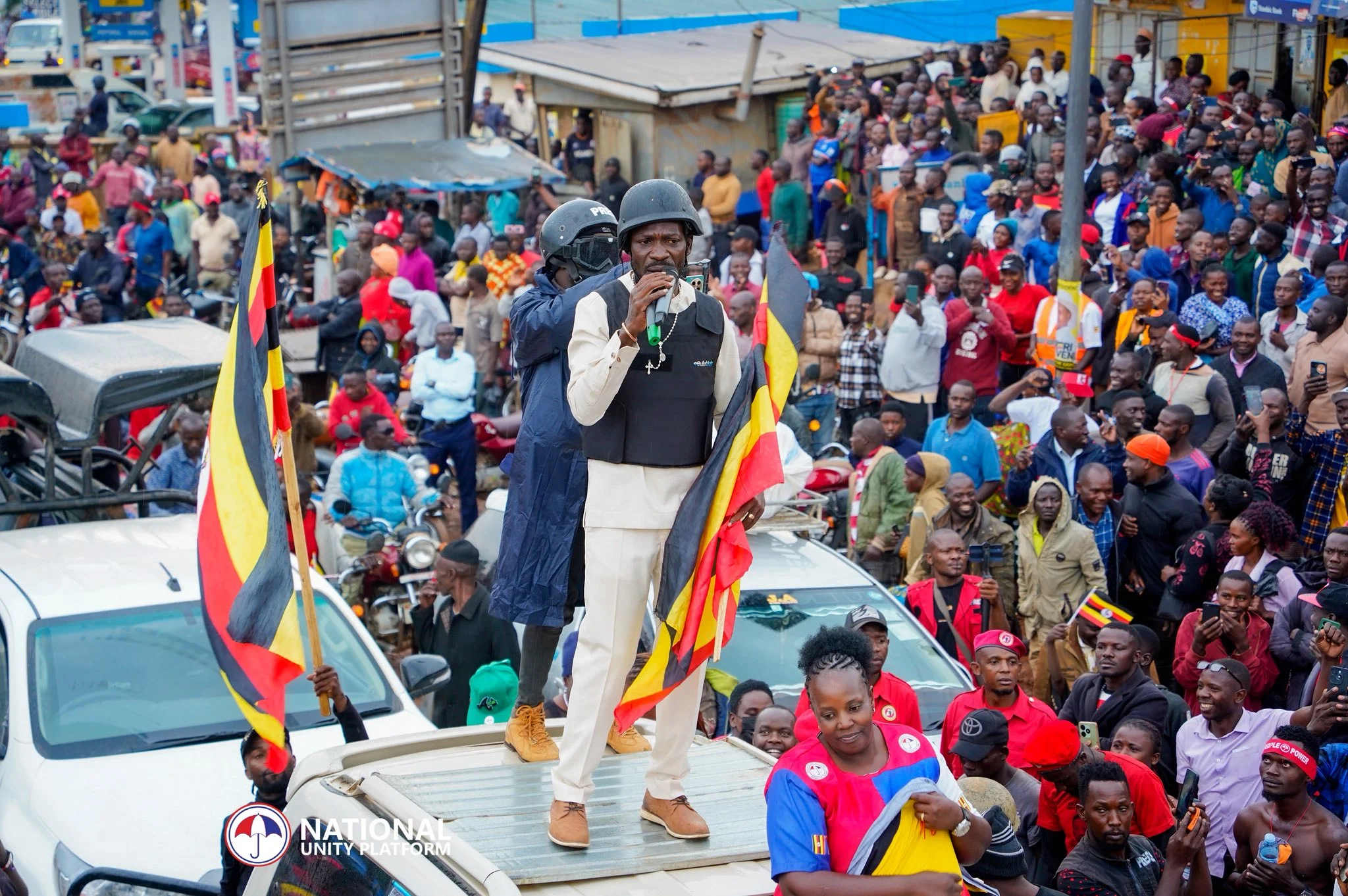
Uganda’s 2026 election campaign unfolded in ways that even seasoned observers did not fully anticipate. While elections in the country are often characterised by strong state control, heavy security, and restricted opposition space, this campaign cycle stood out for its symbolism, intensity, and political undercurrents. As Ugandans prepared to vote on 15 January, the campaign revealed a system adapting to pressure rather than opening up—producing moments that reshaped public debate and expectations.
Below are 10 defining moments that made this campaign one of the most unusual in Uganda’s recent political history.
1. Bobi Wine’s Helmet and Flak Jacket Become Political Symbols
Few images captured the campaign more vividly than opposition leader Bobi Wine addressing supporters while wearing a helmet and flak jacket. What began as a personal security measure quickly evolved into a national symbol of political risk and repression. Supporters saw it as proof of courage under threat, while critics argued it reflected how deeply securitised Ugandan politics has become.
2. Museveni’s Unchanging Stability Narrative
President Yoweri Museveni ran a campaign anchored in familiarity. His message of stability, continuity, and economic progress echoed previous elections, framing the vote as a choice between preserving achievements and risking uncertainty. After nearly four decades in power, Museveni relied on experience and incumbency rather than novelty.
3. A Campaign Conducted Under Heavy Security
From start to finish, security forces were omnipresent. Police trucks, soldiers, and riot units followed campaign trails, especially those of opposition candidates. Authorities insisted deployments were preventive, but their scale shaped voter psychology and limited spontaneous political engagement, reinforcing the sense of a tightly managed contest.
4. Arrests and Detentions of Opposition Supporters
The campaign period saw repeated arrests of opposition activists and local organisers, particularly from the National Unity Platform. Many detentions were short-lived but frequent, creating exhaustion and fear. Rights groups described the pattern as strategic disruption rather than law enforcement.
5. The Internet Blackout and Digital Restrictions
Days before polling, Uganda once again entered an internet shutdown. Social media platforms and messaging services were restricted under orders from the Uganda Communications Commission. The blackout limited live reporting, mobilisation, and independent verification, prompting condemnation from civil society and the United Nations Human Rights Office.
6. Delayed Starts and Logistical Disruptions
As election day approached, concerns grew over logistical readiness. Past experiences resurfaced as some campaign events and voter education exercises were disrupted by late deliveries, technical failures, and unclear communication. These challenges fed opposition claims that administrative weaknesses disproportionately affect urban and opposition-leaning areas.
7. A More Subdued Opposition Momentum Than 2021
Unlike the electrifying atmosphere of 2021, the opposition campaign in 2026 felt more restrained. Years of arrests, surveillance, and legal pressure appeared to have taken a toll. While Bobi Wine remained the central opposition figure, analysts noted reduced energy on the ground and limited expansion beyond core strongholds.
8. Internal Strains Within the Opposition Camp
The campaign also exposed internal opposition challenges. Leadership disputes, defections, and corruption allegations weakened cohesion and messaging. For many voters, these divisions diluted the opposition’s promise of a clear alternative to long-standing rule.
9. The Silent Shadow of Muhoozi Kainerugaba
Although not on the ballot, Muhoozi Kainerugaba loomed large over the campaign. Museveni’s son, now head of the army, remained publicly quiet, but his rise has reshaped discussions about succession. For many observers, the election felt less about defeating the opposition and more about managing the ruling system’s future.
10. A Campaign That Felt Predetermined
Perhaps the most defining aspect was the widespread perception that the outcome was largely settled. With Museveni firmly in control of state institutions and opposition space constrained, many Ugandans viewed the campaign less as a competitive race and more as a confirmation of continuity—raising questions about the role elections play in Uganda’s political system.
What the Campaign Revealed About Uganda
Rather than transforming political expectations, the 2026 campaign exposed underlying realities. Uganda is changing demographically and socially, yet its electoral politics remain highly controlled. Symbols like flak jackets, internet shutdowns, and overwhelming security spoke louder than policy debates.
As voters headed to the polls, the campaign’s defining moments suggested that Uganda’s most important political questions lie beyond this election—centred on succession, generational pressure, and whether meaningful reform can occur within the existing system.


