Senator’s Provocative Action Shocks Australian Parliament
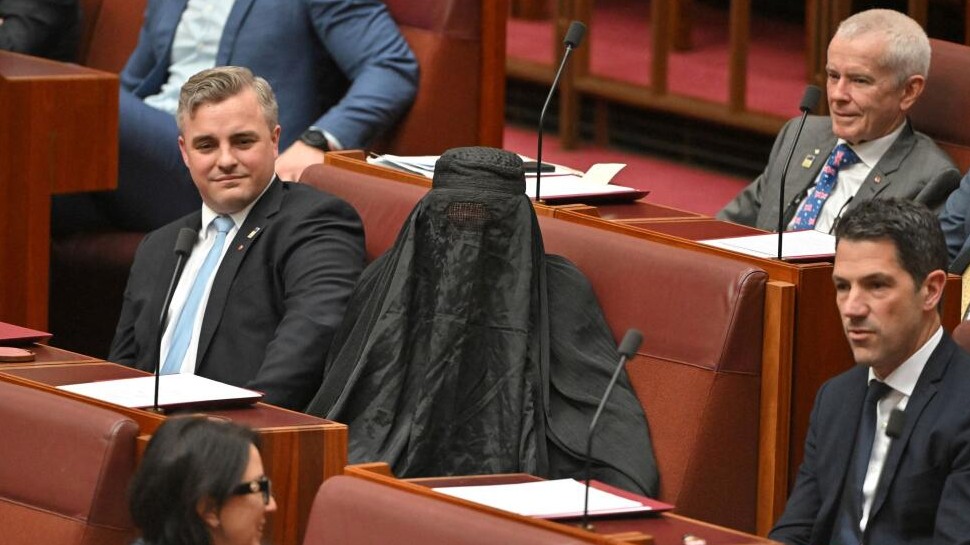
In a stunning and controversial move, Australian Senator Pauline Hanson was suspended from Parliament following a provocative stunt involving the wearing of a burka during a parliamentary session. The stunt, which was intended as a political statement, quickly sparked a wave of outrage and calls for disciplinary action. Hanson, a long-time member of the right-wing One Nation party, donned the full-body covering in protest against the growing Muslim population in Australia. The incident has raised deep concerns about the limits of free expression in political spaces and the responsibility of elected officials to uphold respect and dignity while engaging in public discourse.
Hanson’s actions were meant to underscore her opposition to the perceived rise of Islamic influence in Australia. However, the stunt has divided opinion across the political spectrum, with many condemning it as offensive and disrespectful, while others see it as a legitimate expression of political freedom. The move has reignited discussions about the role of religion in public life, particularly in a multicultural society like Australia, and whether such acts should be tolerated by the government and its institutions.
The Burka Stunt: A Political Statement or Cultural Insensitivity?
Senator Hanson’s decision to wear a burka during an official parliamentary session was met with immediate backlash from politicians, community leaders, and members of the public. The burka, a traditional Muslim garment worn by some women as part of their religious practice, has been a contentious topic in Australian political discourse. Hanson’s stunt came in the wake of debates around the integration of Muslim communities into Australian society, and particularly the increasing presence of Islam in the country.
Hanson, known for her outspoken views on immigration and national identity, claimed that her intention was to raise awareness of what she sees as a threat to Australian values posed by radical Islamic extremism. She argued that wearing the burka symbolized the growing influence of Islam in the country and emphasized her call for a ban on the garment. While some supporters of Hanson’s views applauded her actions as a bold stand for national security and values, many others criticized the stunt as culturally insensitive, inflammatory, and discriminatory.
Immediate Consequences: Suspension from Parliament
The stunt prompted swift action from Australian parliamentary authorities, who suspended Senator Hanson for the remainder of the day’s proceedings. Speaker of the House, Tony Smith, called Hanson’s behavior “unacceptable,” noting that her actions violated parliamentary rules that require members to behave with decorum and respect for all individuals. The suspension was a clear signal that such provocative actions would not be tolerated within the legislative process. However, Hanson defended her actions, claiming that she had not disrupted the business of Parliament and that her right to free expression should be protected.
While the suspension was a temporary measure, the long-term implications for Hanson’s political career remain uncertain. Some observers predict that the stunt could harm her standing with moderates and swing voters, while others believe it will bolster her appeal among her core base of supporters who share her views on immigration and multiculturalism. Either way, the incident has cast a shadow over the One Nation party and once again brought Hanson to the forefront of Australian political debate.
Reactions from Political Leaders and the Public
The burka stunt has sparked a wide range of reactions across the political landscape. Many political leaders, including Prime Minister Scott Morrison, condemned Hanson’s actions, stating that such behavior was divisive and undermined Australia’s multicultural identity. Morrison expressed disappointment that Hanson had used such a sensitive issue to make a political point, particularly in the context of ongoing efforts to foster national unity and cohesion.
Opposition politicians also expressed their disapproval, with some calling for stronger penalties for Hanson’s disruptive behavior. Labor’s Shadow Minister for Foreign Affairs, Penny Wong, stated that Hanson’s stunt was a “disgrace” and underscored the need for politicians to exercise restraint and respect for cultural diversity. Wong, along with several other leaders, emphasized that Australia’s strength lies in its multicultural society, where people of all backgrounds are entitled to live, work, and express themselves freely.
However, Hanson’s supporters rallied around her, claiming that the backlash was a direct result of political correctness and an unwillingness to engage in honest debates about immigration and security. Some of her followers applauded her for standing up to what they saw as the unchecked spread of Islam in Australia, and for calling attention to the perceived dangers of a more open immigration policy.
The Broader Debate on Religion and Multiculturalism in Australia
The burka stunt has brought into sharp focus the ongoing debate over Australia’s approach to multiculturalism and immigration. Australia is a nation with a rich history of cultural diversity, but tensions have surfaced in recent years, particularly in relation to the integration of Muslim communities. The issue of the burka, which some view as a symbol of religious oppression, has become a lightning rod for discussions about Australian values and identity.
While Hanson’s actions have been widely criticized for their cultural insensitivity, they reflect a larger conversation about the challenges of balancing freedom of speech with the rights and dignity of minority groups. The stunt highlights the growing polarization in Australian politics, where issues of immigration and national security are often framed in terms of identity, fear, and division.
What’s Next for Senator Hanson and Australian Politics
As Senator Hanson faces backlash for her actions, her political future remains uncertain. While the suspension from Parliament may have temporarily sidelined her, it has also ensured that her views will remain in the public eye. It remains to be seen whether Hanson will continue to use such provocative tactics to raise her profile or if she will soften her approach in response to growing criticism.
In the larger context of Australian politics, the burka stunt is a reminder of the continuing tensions surrounding multiculturalism, immigration, and national identity. As the nation grapples with these issues, political leaders will need to find ways to navigate the complex terrain of cultural diversity while ensuring that all Australians, regardless of background, feel respected and included.
The Enduring Controversy of Political Stunts
Senator Pauline Hanson’s burka stunt will likely remain a topic of debate for weeks to come, as it has highlighted deep divisions within Australian society. The stunt has raised important questions about the role of political expression, the limits of free speech, and the responsibility of elected officials to uphold the values of respect and inclusion. While Hanson’s supporters may view her actions as brave and necessary, her critics argue that such tactics only serve to divide the country further. Whatever the outcome, this incident has further cemented Hanson’s place in Australian political history, for better or for worse.