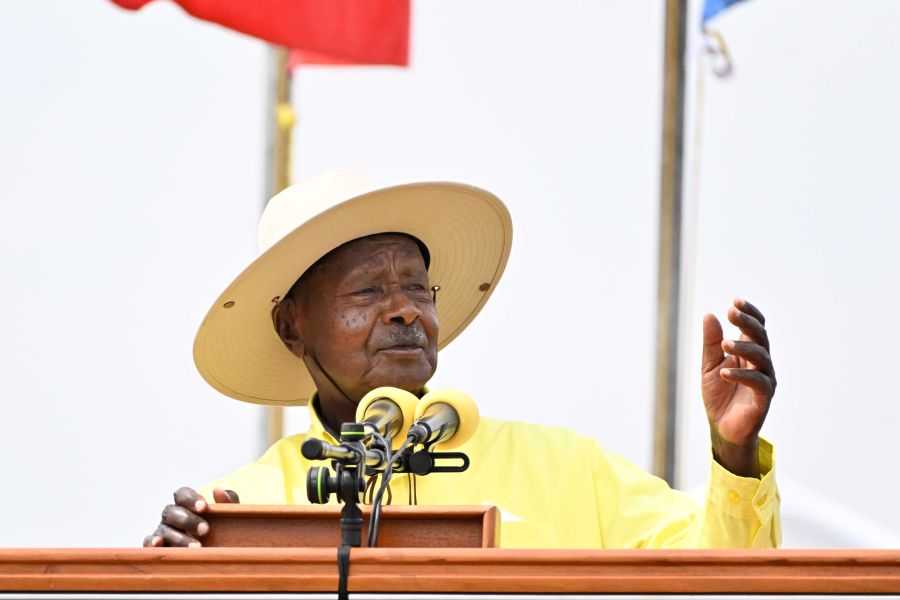
In a significant political moment, President Yoweri Museveni received formal endorsements from Uganda’s business community at the Kampala Business Forum 2025, where entrepreneurs and executives gathered to express their support for his bid for a seventh consecutive term. During the forum, which took place at the Serena Conference Centre, Museveni emphasized his commitment to further enhancing the country’s infrastructure by leveraging revenues from the oil and gas sector, set to be commercialized next year.
Business Community Endorsement: A Show of Confidence in Museveni’s Leadership
The endorsement of Museveni by Uganda’s business community is not a mere formality; it reflects a deep appreciation for the stability and economic progress many entrepreneurs have experienced during his presidency. During the forum, several business leaders, including CEOs and top executives, praised the President for creating a conducive environment for businesses to flourish. They credited the peace and security under his leadership as a major factor in the growth of their enterprises.
President Museveni responded to these endorsements by acknowledging the pivotal role that Uganda’s growing middle class plays in driving the economy. He specifically pointed out sectors like agribusiness, manufacturing, and services as key contributors to the country’s economic engine. “The Ugandan middle class runs the engines of the economy through agribusiness, manufacturing, and other services,” Museveni stated, emphasizing his administration’s support for these sectors.
The endorsement also came as part of the broader sentiment that the business community’s prosperity was directly linked to Museveni’s leadership. The President’s address was well-received by the forum’s attendees, with many crediting his policies for fostering an environment where businesses could grow. The endorsement of Museveni by these influential business leaders serves as a testament to the positive economic changes attributed to his governance.
The Role of Oil Revenues in Infrastructure Development
A central theme in Museveni’s address was the pledge to invest heavily in infrastructure using the forthcoming revenues from Uganda’s oil and gas sector. With commercial oil production expected to begin next year, Museveni sees this as a critical opportunity to reduce the cost of doing business in Uganda. He promised to allocate oil revenues toward enhancing transportation, power, and logistics infrastructure, which he believes are key to lowering operational costs for businesses across the country.
Improved infrastructure, according to the President, is essential for sustaining the growth of the middle class, which he sees as the backbone of Uganda’s economy. By investing in roads, electricity, and modern logistics networks, Museveni hopes to make Uganda a more competitive place to do business, attracting more investment and fostering economic growth. The promise to direct oil revenues into infrastructure development resonates with the business community, which has long highlighted the lack of modern infrastructure as a barrier to expansion and increased productivity.
Divisions Within Kampala’s Trader Leadership
While Museveni’s endorsement from the business community was unanimous, the event was not without its divisions. The absence of top leadership from the Kampala City Traders Association (KACITA) was noticeable, and their absence raised questions about the broader support base for Museveni’s policies. The tension within Kampala’s trader leadership was further exemplified by the presence of splinter factions attempting to gain the President’s attention.
John Kabanda, the President of the Federation of Uganda Traders Association (FUTA), appealed directly to the President during the forum, requesting a meeting to discuss the grievances of traders, especially those affected by flooding in Kampala. “Mr. President, we humbly request that you give us a date to meet as traders. Since the flooding in Kampala, we have had grievances but have never had a chance to discuss them with you,” Kabanda said.
In response, Museveni granted their request and promised to meet with them, saying, “I am going to tell my team so that I can meet you for one hour in Kisozi.” He also took a swipe at KACITA, criticizing its leadership as a “comprado bourgeoisie” (a term implying that the group is serving the interests of foreign capitalists rather than local traders). This exchange between Museveni and the traders reflected the underlying discontent within certain sections of the business community, particularly among smaller traders who feel sidelined by the policies favored by larger corporate interests.
Museveni’s Middle-Class Support: A Critical Factor in the Election
Museveni’s endorsement from the business community, especially the middle class, is likely to be an important factor in the upcoming election. For years, the middle class has been a key demographic for the President, who has positioned himself as a champion of economic growth and development. The middle class in Uganda has been expanding rapidly, and many entrepreneurs have attributed their success to the stable environment created by Museveni’s leadership.
By focusing on the middle class as the engine of the economy, Museveni’s campaign seems geared toward securing the backing of a significant voter bloc. His pledge to reinvest oil revenues into infrastructure projects aligns with the needs of this demographic, which seeks to reduce the cost of living and doing business. The endorsement, however, does not come without challenges, as demonstrated by the divisions within Kampala’s trader leadership and the growing concerns of small traders who feel left out of the benefits brought by large-scale economic policies.
A Vision for the Future: Challenges and Opportunities
Museveni’s promises to use oil revenues to enhance infrastructure and his focus on the middle class signal a forward-looking approach to Uganda’s development. However, the success of these initiatives will depend on several factors, including how effectively the government can implement these infrastructure projects and ensure that the benefits are felt across all sectors of the economy, particularly by smaller businesses and traders.
The President’s leadership in addressing issues of infrastructure, particularly by tapping into Uganda’s natural resources, has the potential to transform the economic landscape of the country. But it is clear that his support base is not as homogenous as it once appeared. The divisions within Kampala’s trader leadership and the challenges of addressing the needs of the informal economy represent areas where Museveni will need to tread carefully as he navigates his re-election bid.